Inside the Misteri di Trapani
My Connection with the Misteri di Trapani
My connection with the Misteri di Trapani began in 2014, when my son and I went looking for a new photographic adventure in Sicily.
We had heard about an extraordinary Easter procession in Trapani, but beyond that we knew very little. There was no grand plan, no long-term documentary project and certainly no expectation that this first journey would begin a relationship with the city that continues more than a decade later.
We simply booked our flights and went to experience it for ourselves. Like many of the best photographic journeys, it began with curiosity.
We arrived as father and son, carrying cameras and an open mind. We wanted to explore Trapani, immerse ourselves in the atmosphere and photograph whatever unfolded in front of us. What we discovered was far richer than either of us had anticipated.
As Easter approached, the city seemed to move to a different rhythm. Churches filled with activity, bands rehearsed in the narrow streets and families gathered in anticipation of the days ahead. Everywhere there was a sense of history, faith, tradition and belonging.
Through chance encounters and introductions, local people welcomed us into their world and gradually gave us glimpses behind the scenes of a tradition that has shaped Trapani for centuries. What began as a simple photography trip to Sicily quickly became something much more personal.
Most importantly, we made photographs that excited us, not because they were technically perfect, but because they captured something real: emotion, atmosphere and human connection. That first visit changed the way I saw the Misteri and began a documentary story I am still photographing today.
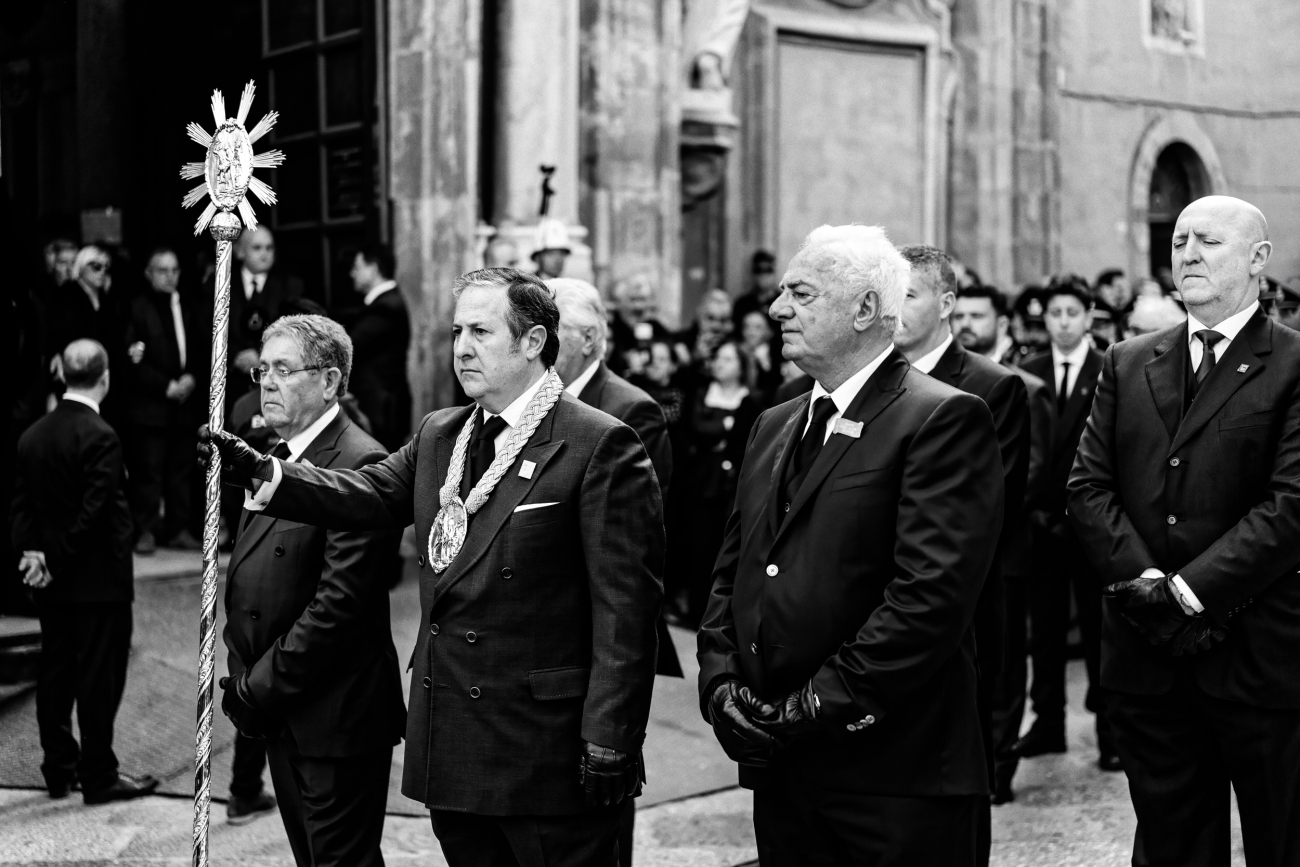
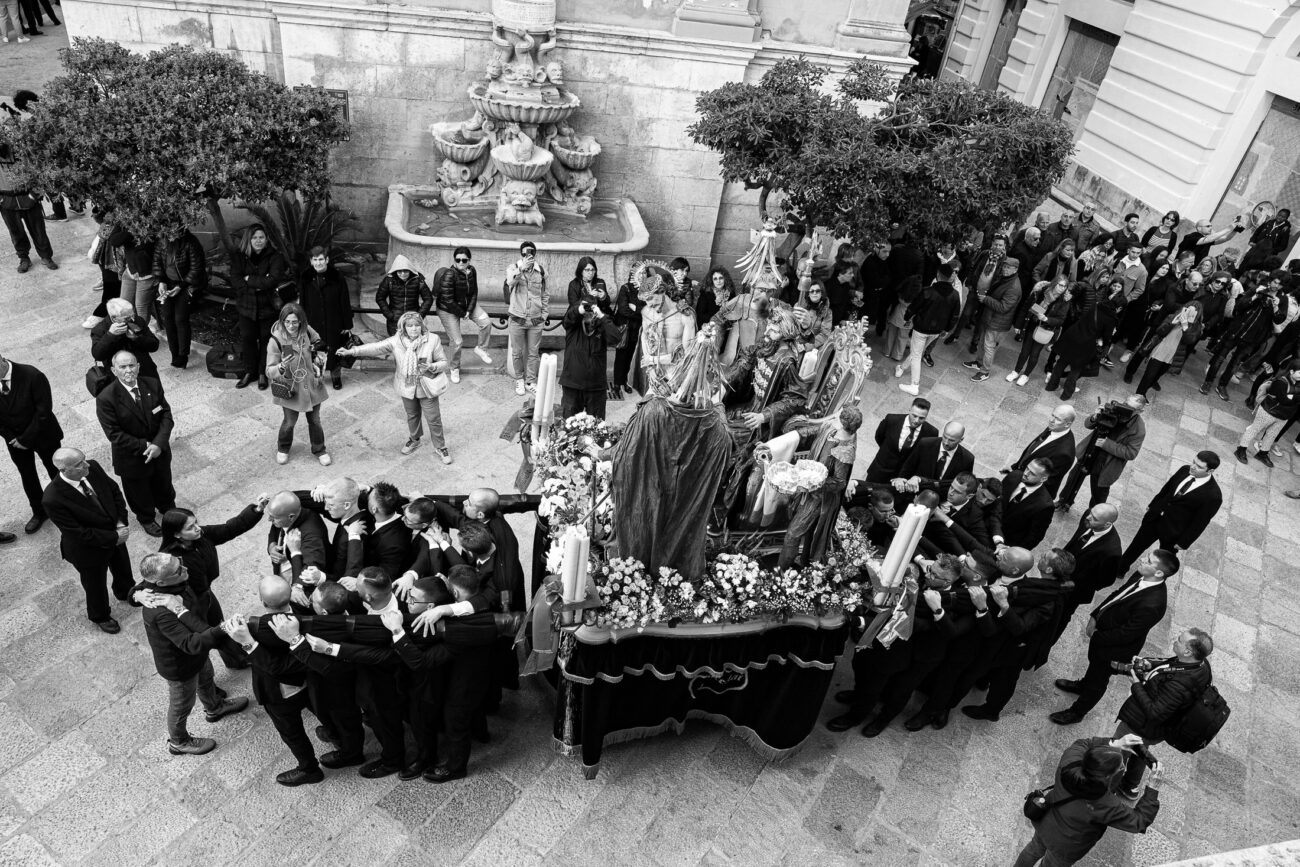
A City Transformed
Although the Misteri di Trapani procession begins at 2pm on Good Friday and continues until around 2pm on Saturday, my experience of the Misteri always begins much earlier. Over the years I’ve learned that some of the most rewarding moments, both personally and photographically, happen long before the first of the sacred groups emerges from the church and begins its journey through the streets of Trapani.
Whenever possible, I arrive at least a day before the procession. The city is already changing. As Easter approaches, there is a growing sense of anticipation. Inside the churches, final preparations are underway as the sacred groups are checked and prepared for the long hours ahead. Musicians gather for rehearsals, volunteers move quietly between tasks, and families spend more time in the streets as one of the most important events in Trapani’s calendar draws closer.
For a documentary photographer, these quieter hours are invaluable. There is time to observe without the intensity of the crowds that will soon fill the historic centre. Conversations happen naturally, and people are often curious about why you’ve travelled to Sicily to photograph their tradition.
Those conversations matter. When people have seen you before, when they understand that your interest goes beyond simply arriving, taking photographs and leaving, trust begins to develop. And with trust comes the opportunity to experience and photograph a side of the Misteri di Trapani that most visitors never see.
Since my first visit in 2014, chance encounters, introductions and, above all, the generosity of local people have gradually opened doors. What began as a photographic journey has developed into friendships that have lasted for more than a decade.
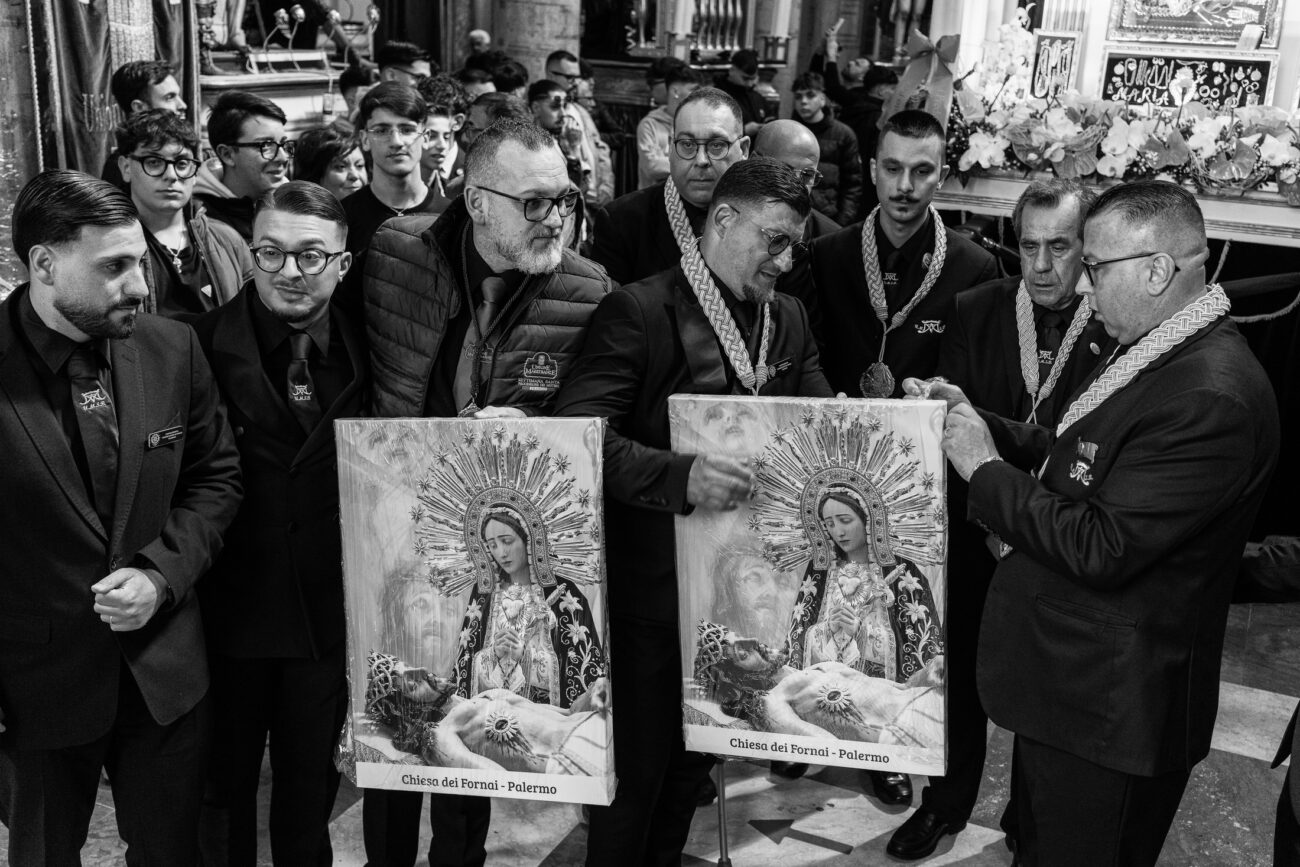
Today I am fortunate to know many of the people who dedicate enormous amounts of time and energy to preserving the Misteri. Among them are Giovanni D’Alì, President of the Unione Maestranze; photographer Sergio Cancelliere, whose portrait studio has long been part of Trapani’s photographic life; and Arturo Safina, whose friendship, encouragement and knowledge have helped me enormously over the years.
Through people like these, I’ve come to understand that the Misteri is far more than an Easter procession in Sicily. The statues, music, ceremony and spectacle are extraordinary, but they are only the visible expression of something much deeper.
What continues to bring me back to Trapani is the extraordinary sense of community surrounding the event. Every year I see people giving their time, sharing their knowledge and working together to preserve a tradition handed down through generations. The procession may last for twenty-four hours, but the pride, commitment and sense of belonging that sustain it exist throughout the year.
It is this human story, as much as the religious and cultural significance of the Misteri, that has kept me returning with my camera for more than a decade.
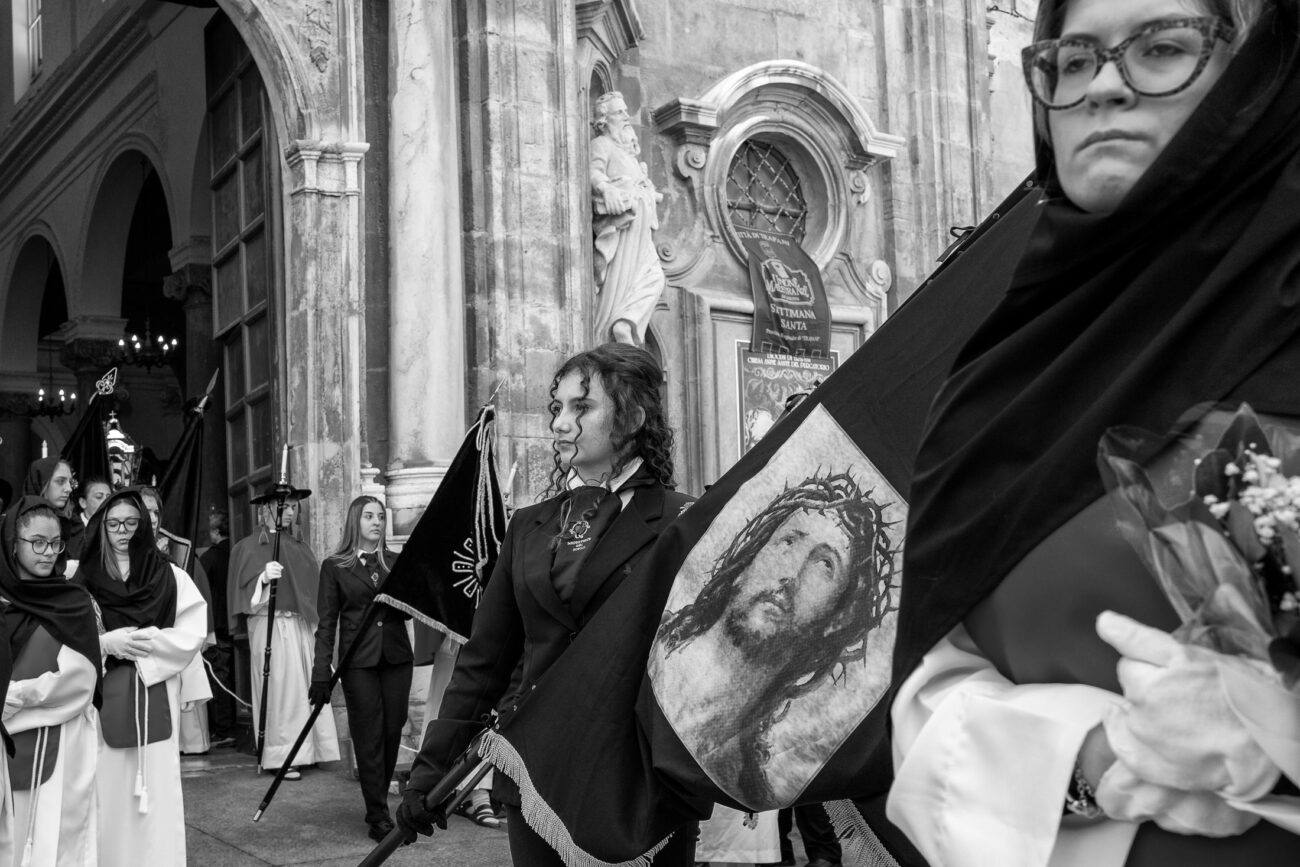
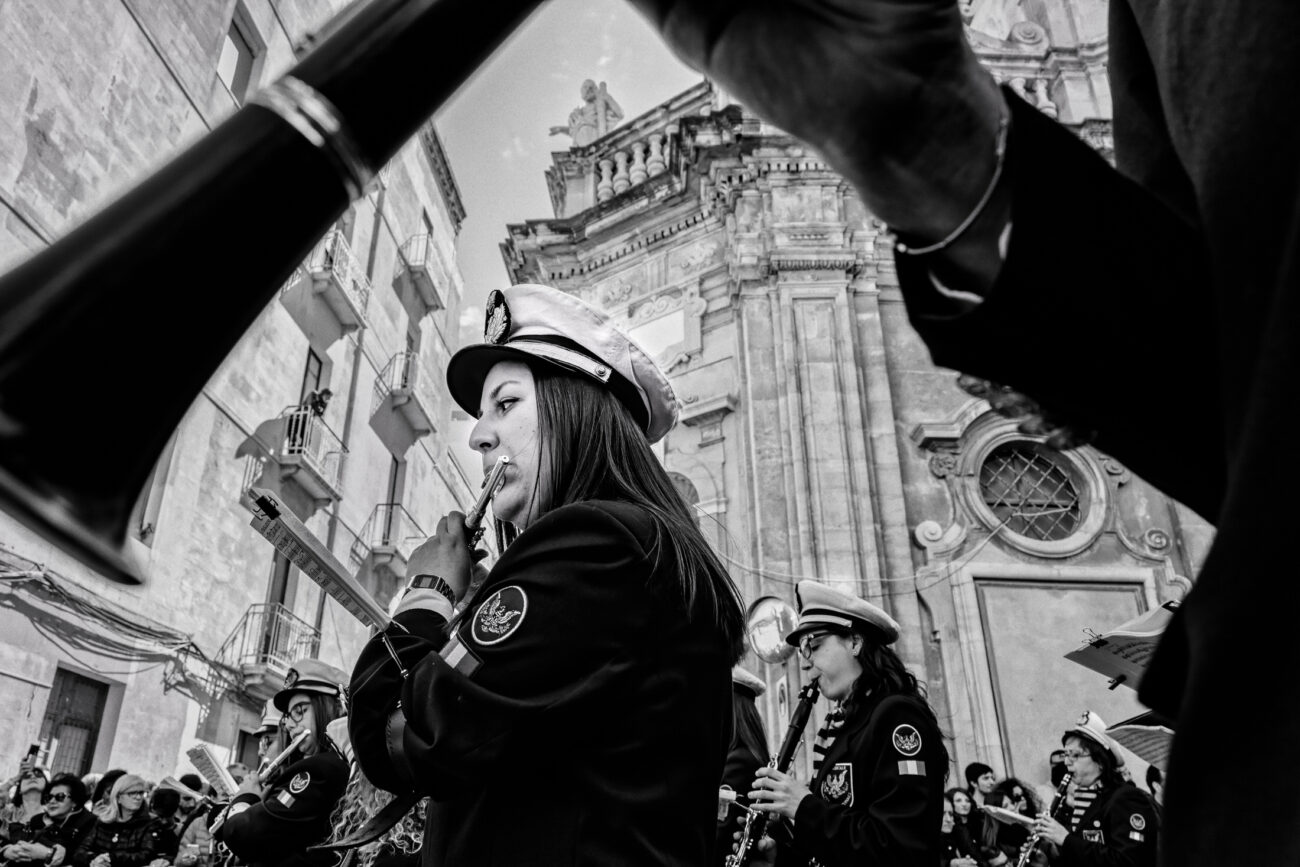
Behind the Church Doors
For most visitors, the Misteri di Trapani begins when the first of the sacred groups emerges into the sunlight on Good Friday afternoon. In reality, the story begins long before that moment.
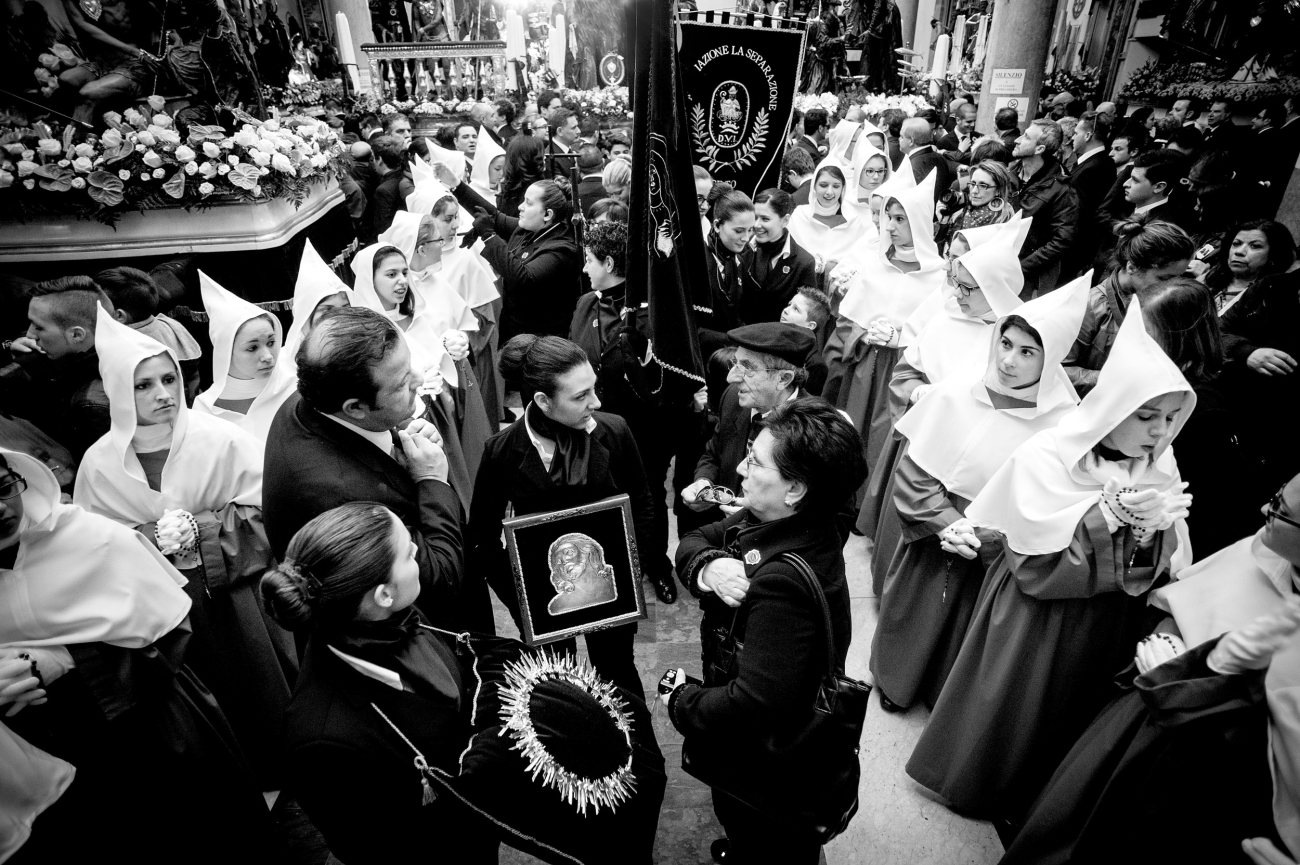
Preparation starts days, and in some cases weeks, before the procession itself. Behind the church doors, volunteers, craftsmen and members of the various groups work together to prepare the sacred sculptures for their journey through Trapani. Every detail matters. Decorations are checked, flowers arranged and countless small tasks completed, often with little fanfare but enormous pride.
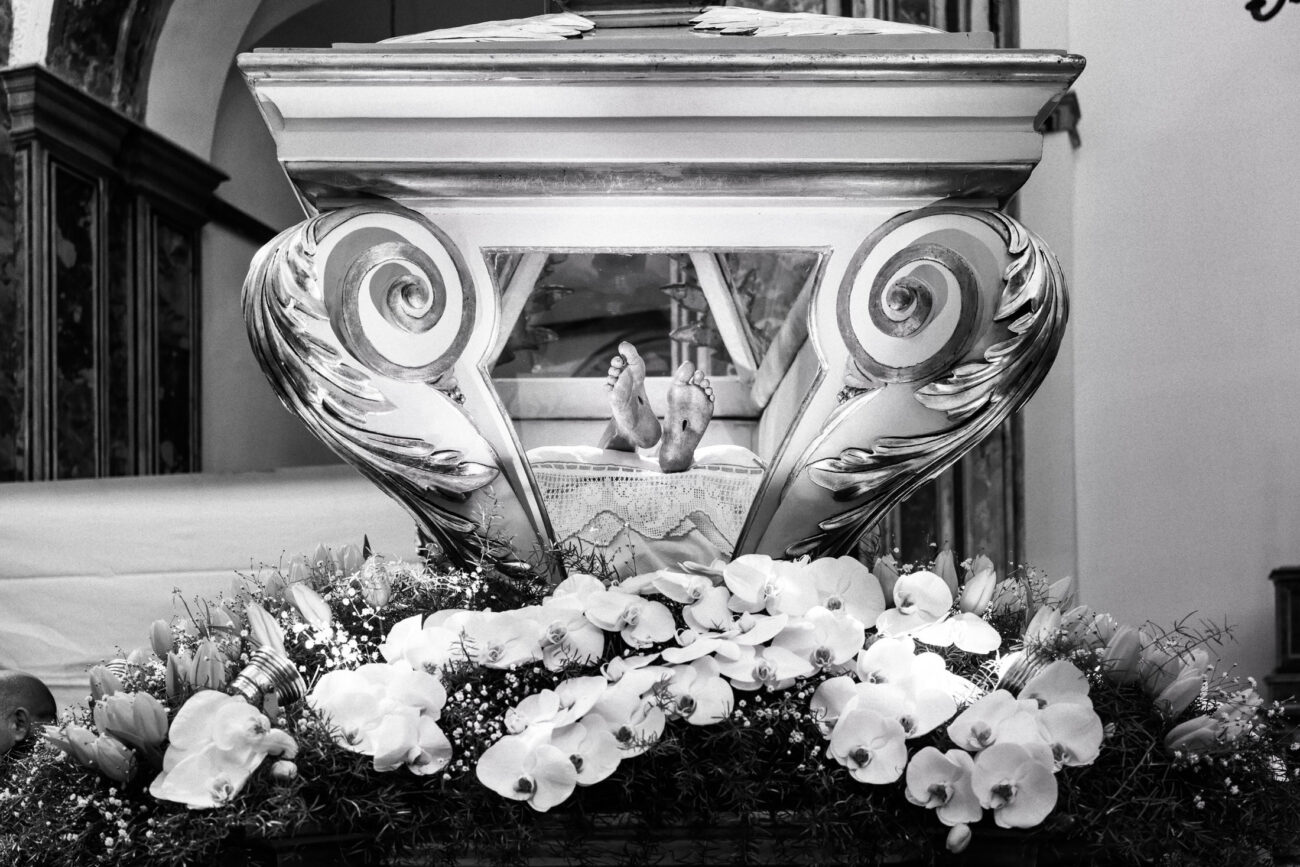
One of the most beautiful stages is watching fresh flowers being added to the groups. Their colour and fragrance bring a sense of life to the sculptures, transforming them from historic objects into something ready to take its place once again at the heart of the city. Each arrangement is carefully considered and becomes part of the visual identity of that year’s procession.
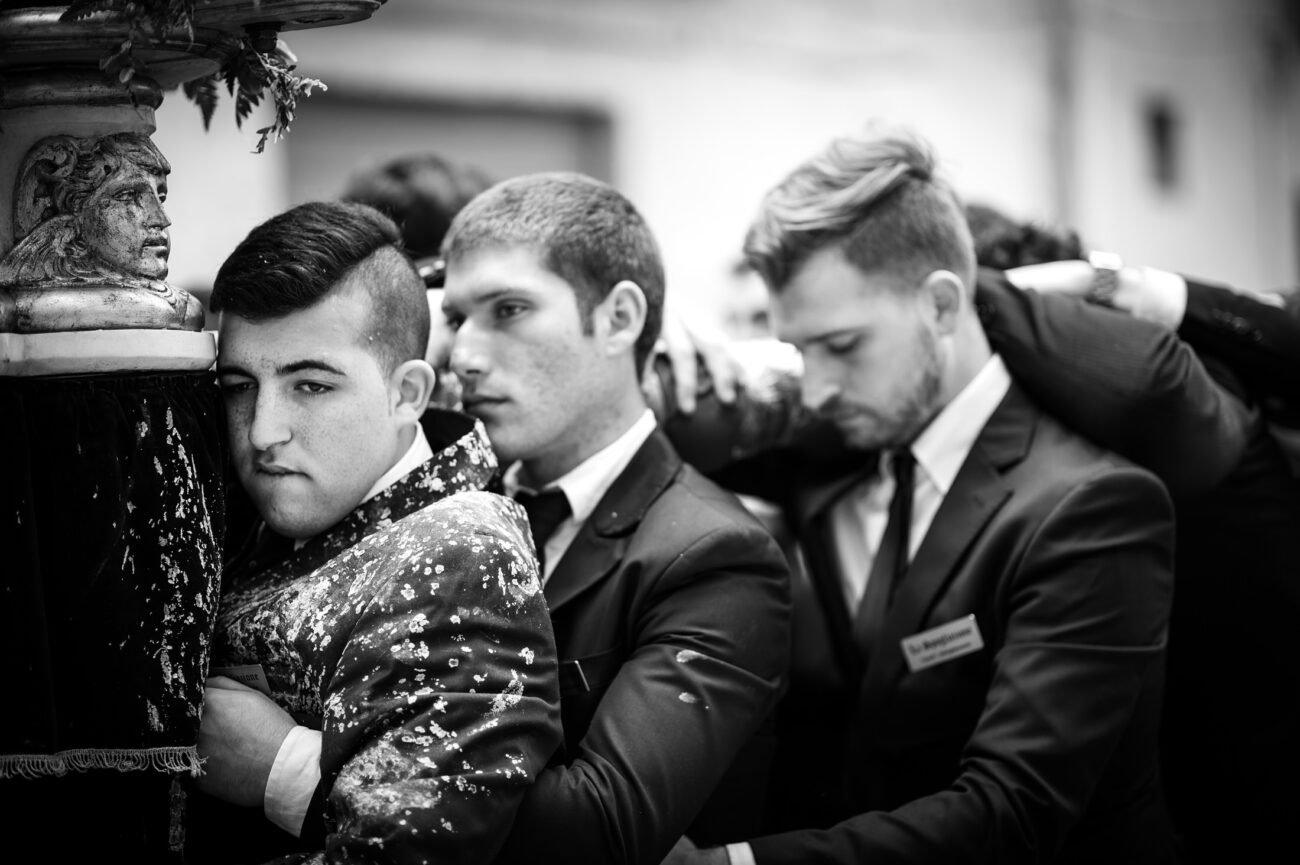
As Good Friday approaches, the long wooden carrying poles are passed through the bases of the groups, ready for the men who will shoulder their weight through the streets for the next twenty-four hours. Worn smooth through decades of use, the poles bear the marks of countless processions and generations of men who have carried the Misteri before them. They are practical objects, yet somehow they also provide a physical connection with the history of the procession itself.
The sacred groups, some dating back centuries, are remarkable to experience at close quarters. Their age is visible in the surfaces, craftsmanship and tiny details that reveal the passage of time. Yet these are not museum pieces. They remain part of a living Sicilian tradition, carefully maintained and restored so that each year they can make the journey through Trapani once again.
Standing beside them in the quiet of the church, before the crowds arrive and before the music begins, you become acutely aware of the history surrounding you.
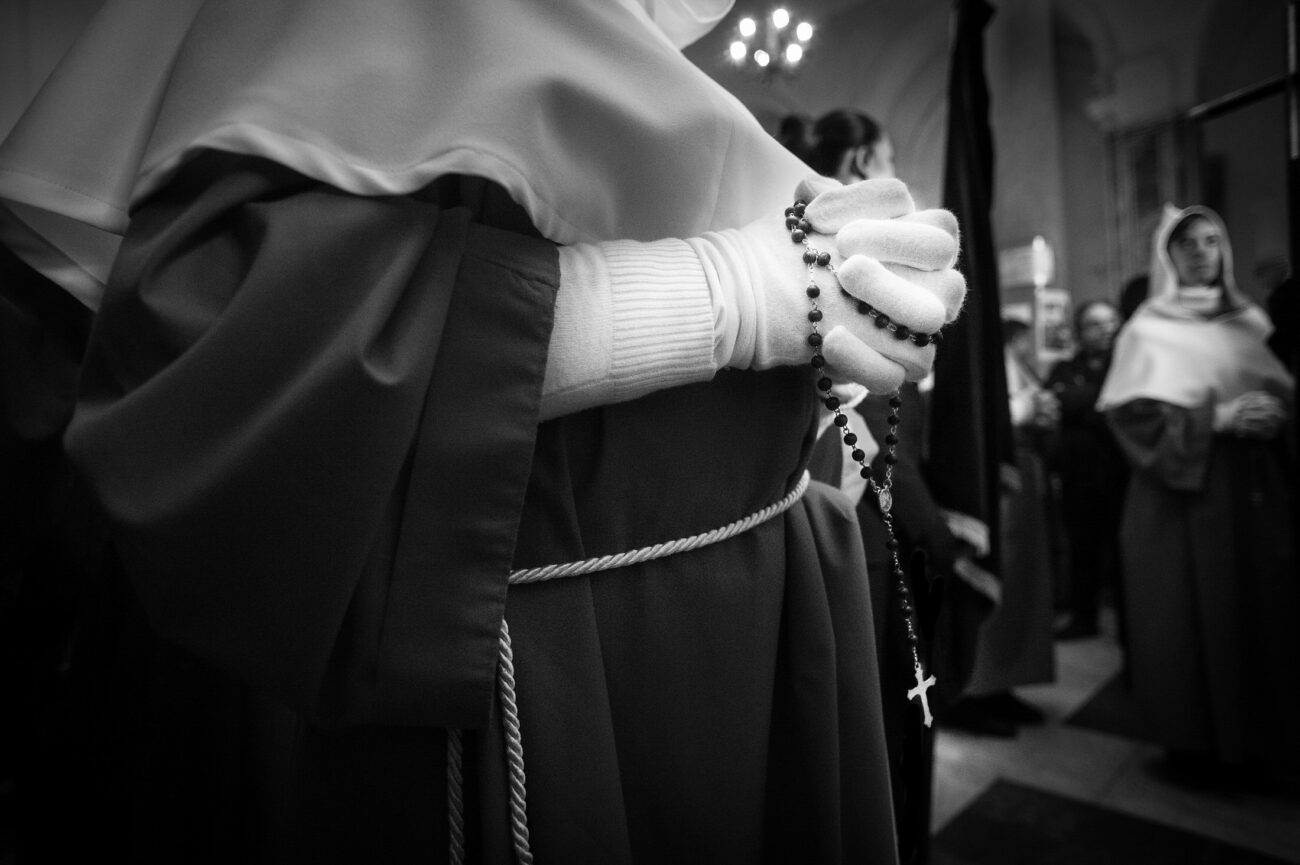
For me, these are some of the most rewarding moments to photograph. The atmosphere is calm and unhurried, offering opportunities for documentary photography that are very different from those found during the procession itself. The photographs become less about spectacle and more about people: the preparation, craftsmanship, dedication and quiet acts of devotion that make the Misteri possible.
It is here, behind the scenes of the Misteri di Trapani, that you begin to understand how much work and care lies behind an Easter tradition that lasts just twenty-four hours, yet has endured in Sicily for more than four centuries.
Twenty Photographs Return Home
In 2025, my long relationship with Trapani reached an unexpected milestone when twenty photographs from my Misteri di Trapani documentary project were selected for a large-scale outdoor exhibition in the city.
Displayed throughout Trapani’s historic centre, the photographs returned to the very streets where many of them had been made over the previous decade. For me, seeing the work exhibited within the community that had welcomed me, trusted me and allowed me to document its extraordinary Easter tradition was enormously moving.
By then, the photographs no longer felt entirely mine. They had become part of a shared story between photographer, city and community.
Read the full story: Twenty Photographs Return Home: An Exhibition in Trapani.
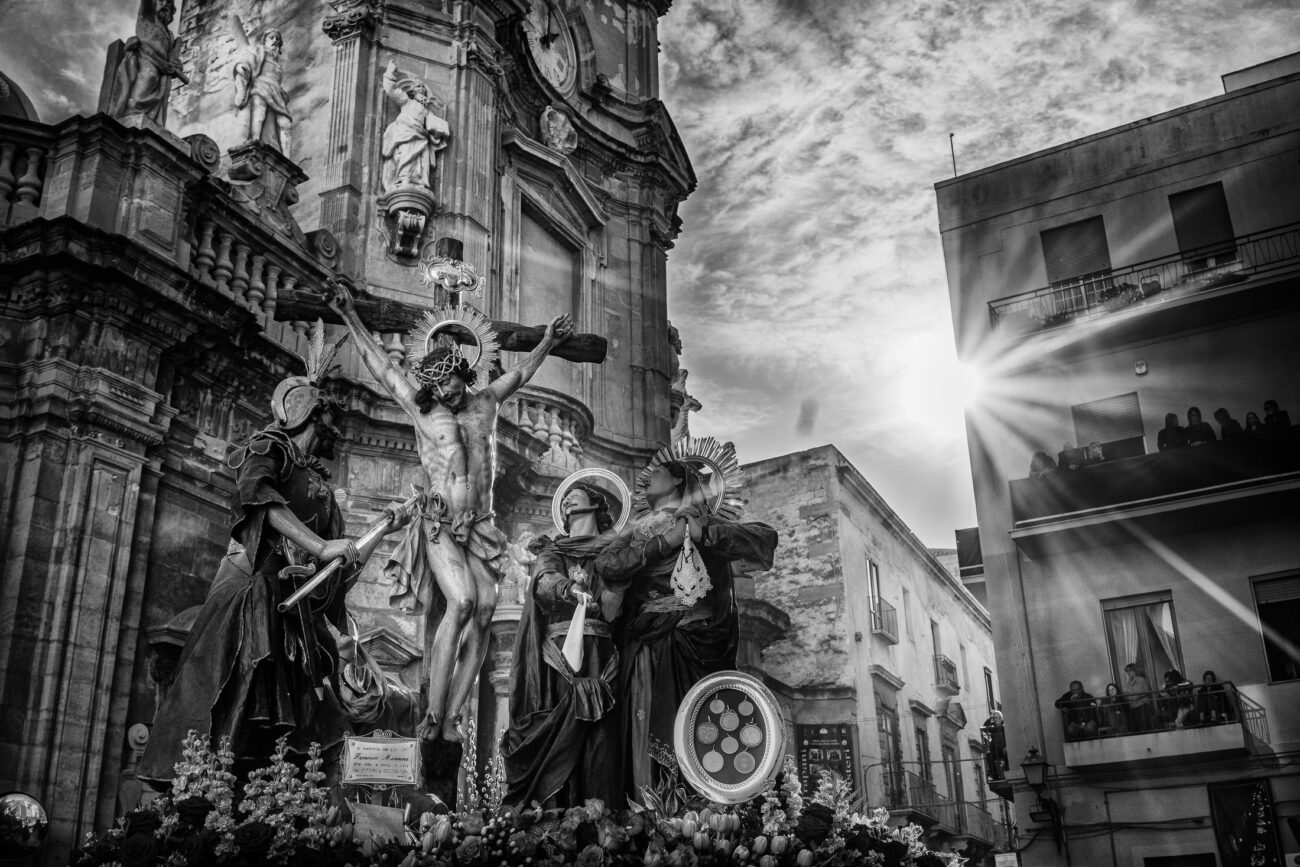
When the Doors Open
As the final preparations are completed and the church fills with anticipation, there comes a moment when everyone knows the waiting is over.
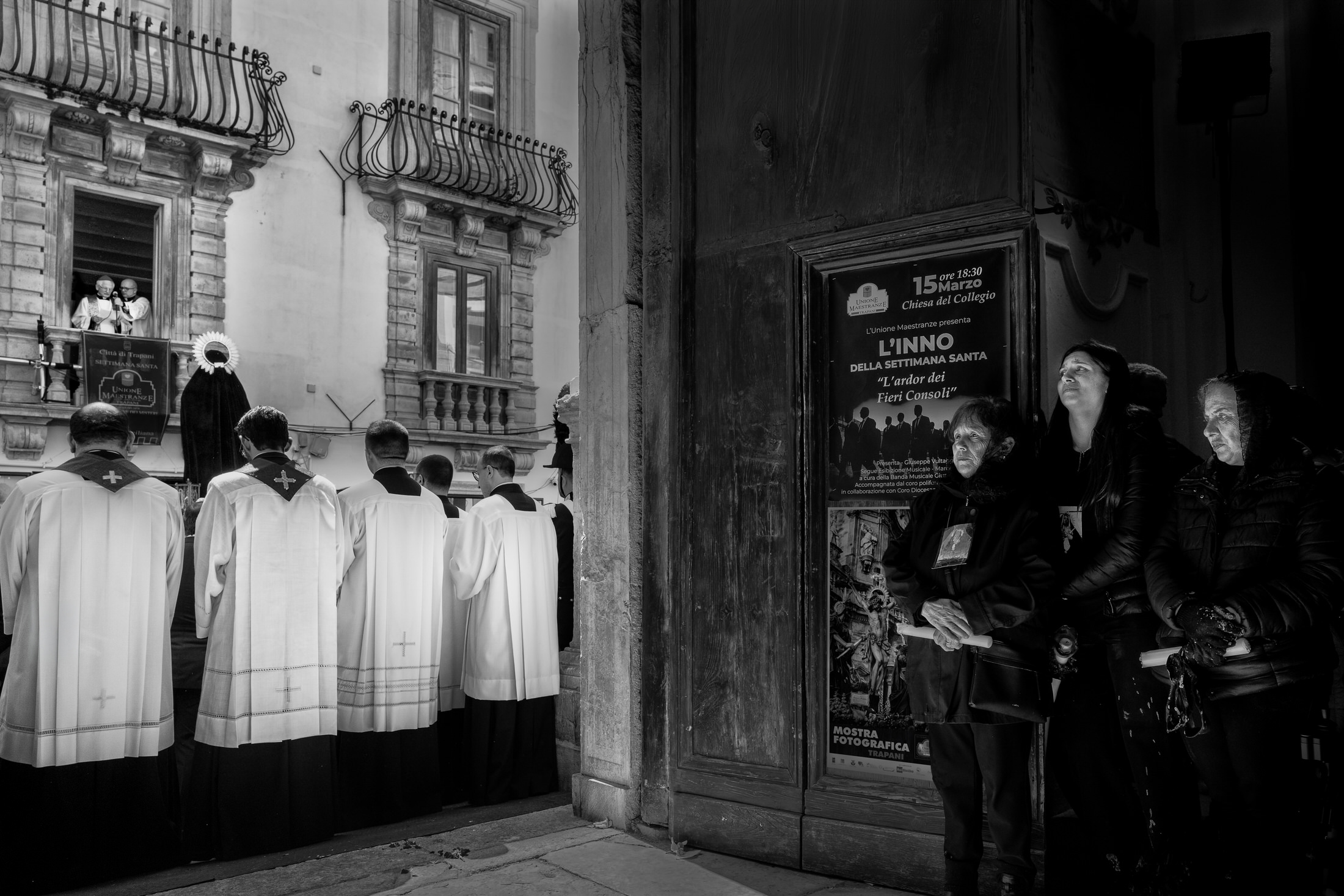
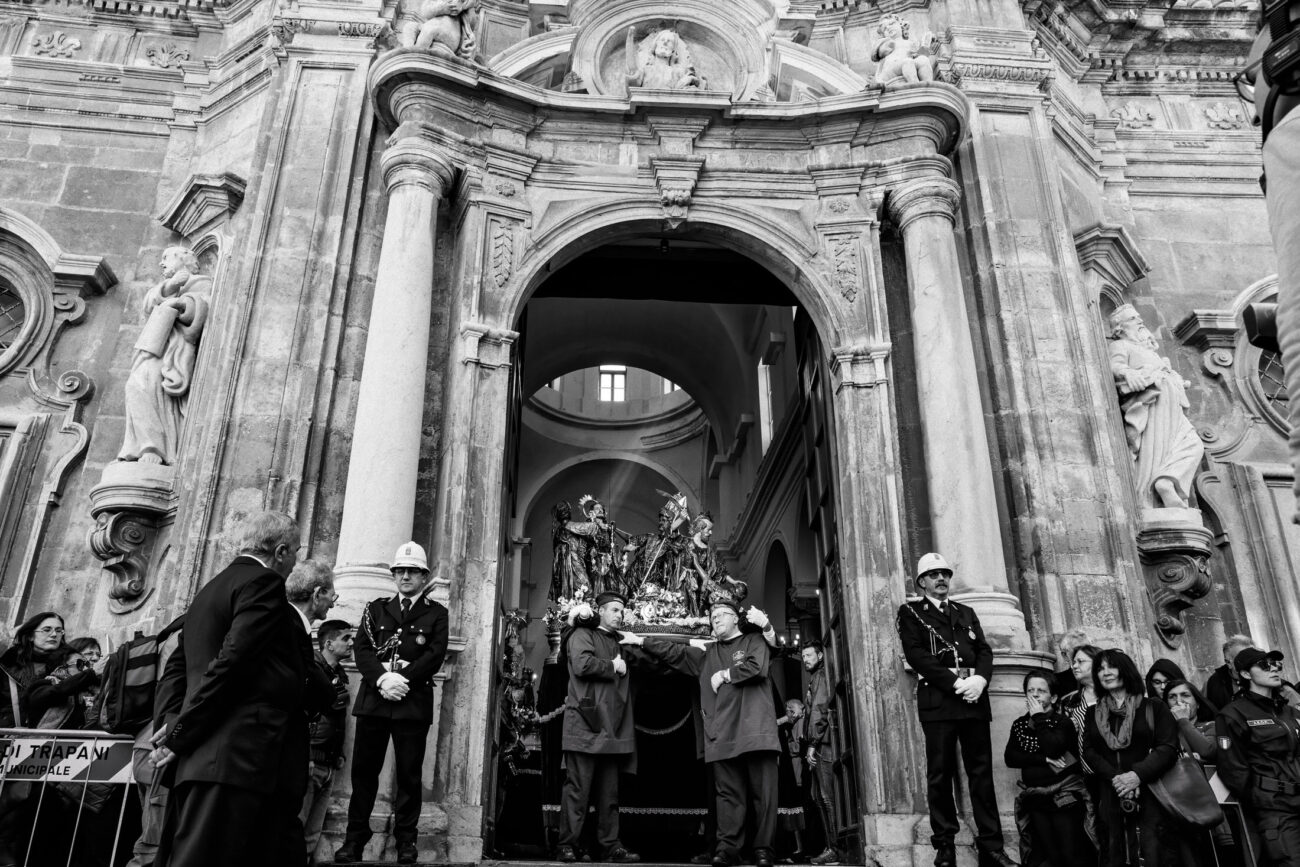
Shortly before 2pm on Good Friday, the atmosphere changes. Conversations become quieter, people take their places and attention turns towards the great doors of the church. Outside, the streets of Trapani are already packed with spectators waiting for the first appearance of the sacred groups. Inside, there is a growing sense of expectation that is difficult to describe until you have experienced it for yourself.
Then the doors open.
Sunlight floods into the church, illuminating the first of the groups waiting in the shadows. After hours of preparation, and weeks of planning before that, the Misteri di Trapani procession is finally ready to begin.
Being inside the church at this moment is an extraordinary privilege and something very few photographers experience. Through relationships built over many years, I have been fortunate to gain access that allows me to photograph these moments from within rather than from the crowded streets outside.
For a documentary photographer, this is about far more than simply having a better position. It is the opportunity to witness the anticipation, emotion and quiet moments that exist behind the public spectacle. It’s a side of the Misteri di Trapani that most visitors to Sicily will never see, and one of the moments I look forward to photographing most each year.
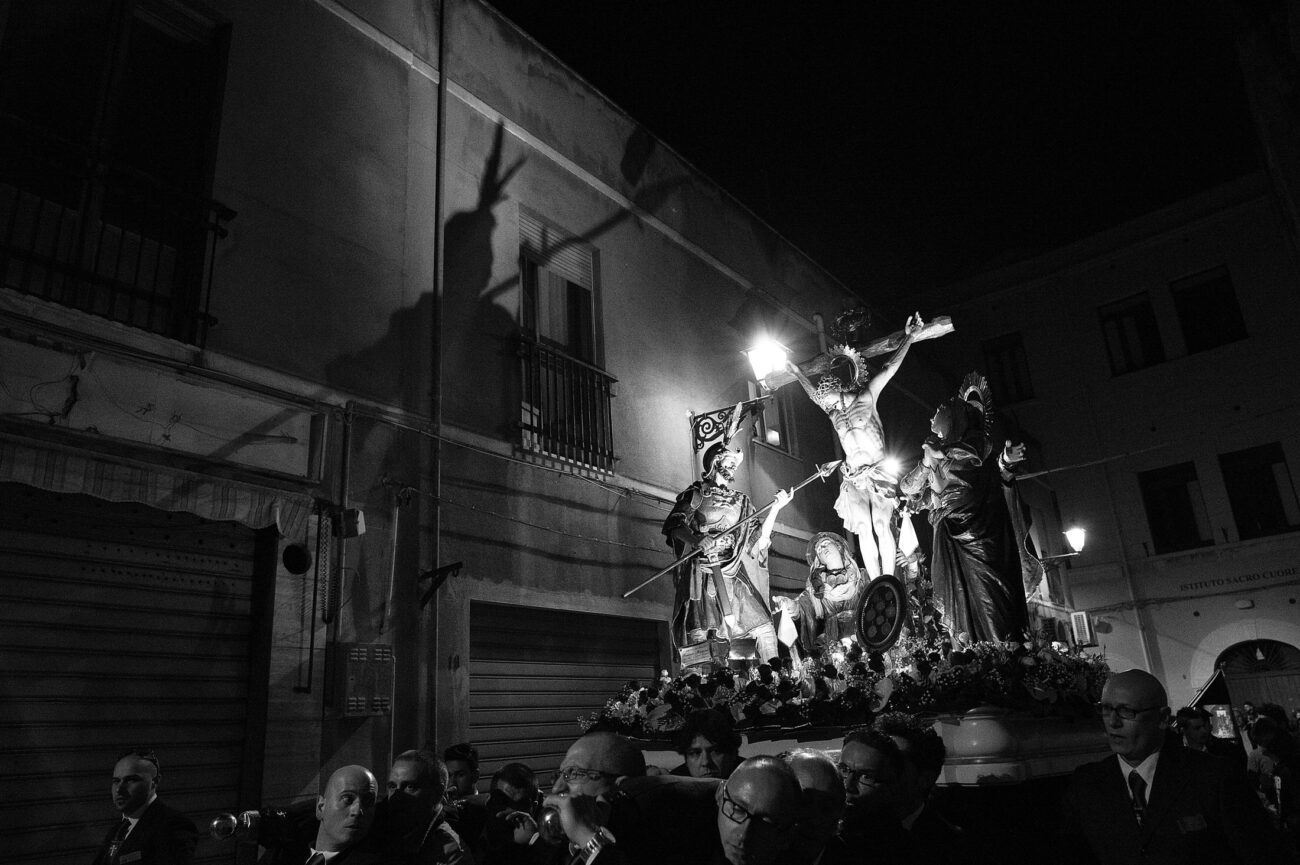
The first band begins to play and the opening group slowly moves forward. There is nothing hurried about its departure. The movement is measured and deliberate, accompanied by music with the character of a funeral march. As the group emerges from the darkness of the church into the bright Sicilian afternoon, the contrast is both visual and emotional. For a moment the crowd falls quiet, and then the long journey through the city begins.
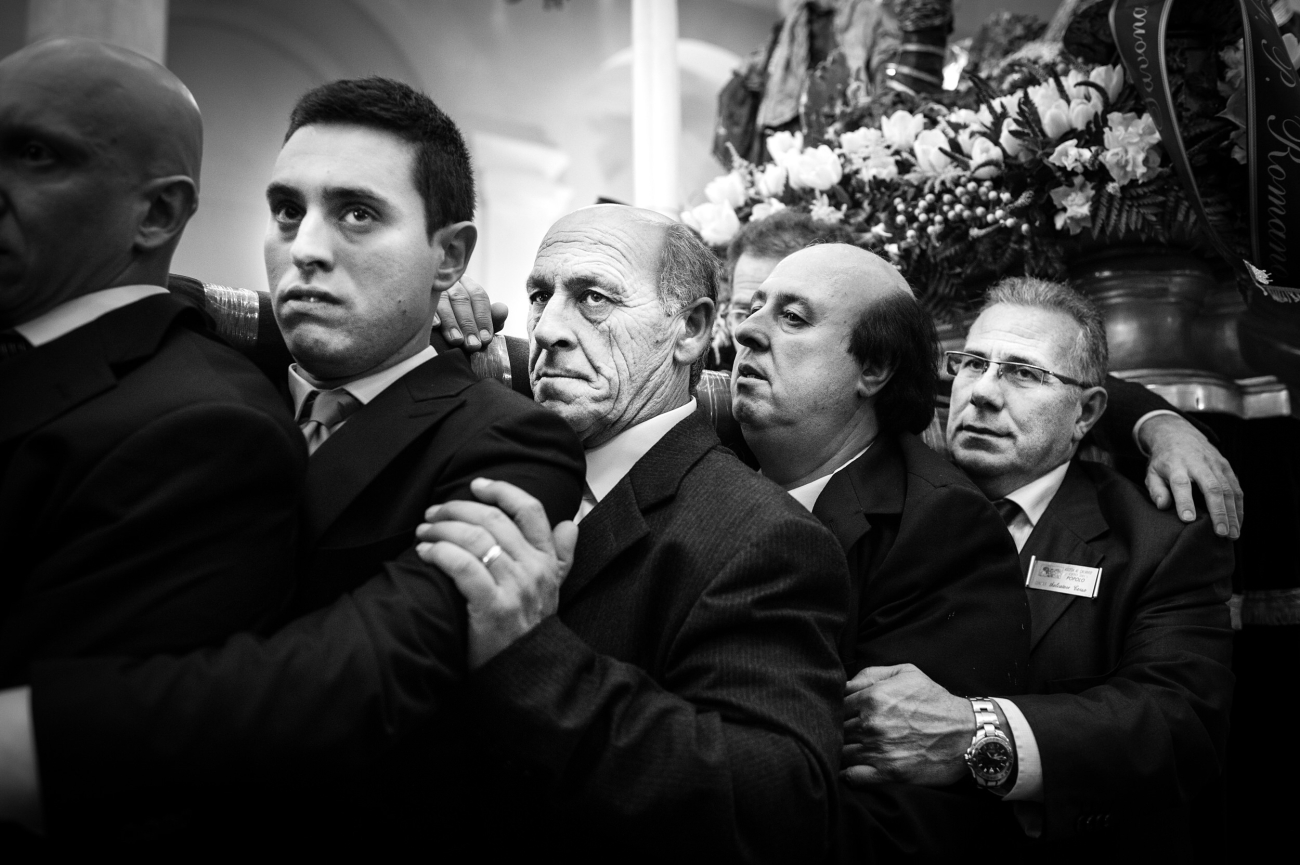
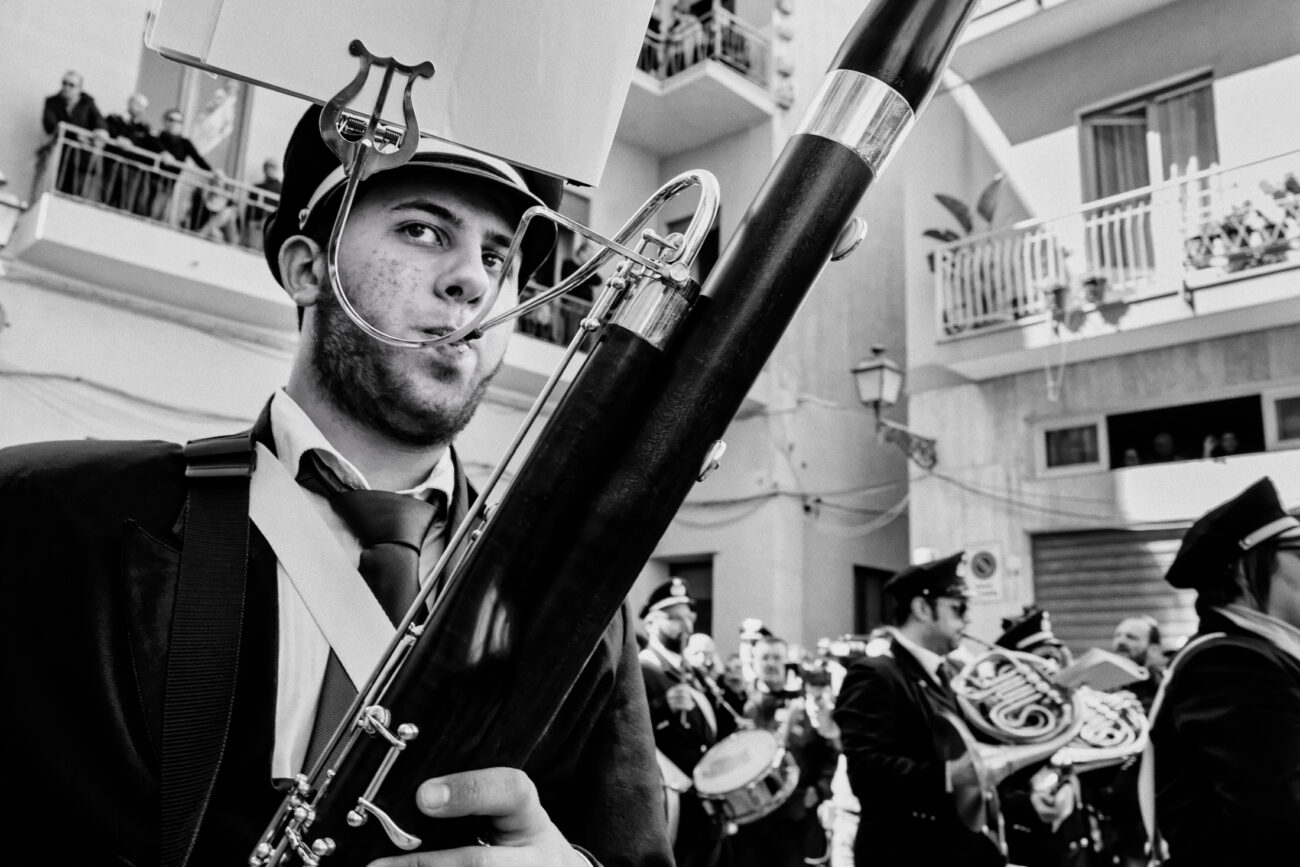
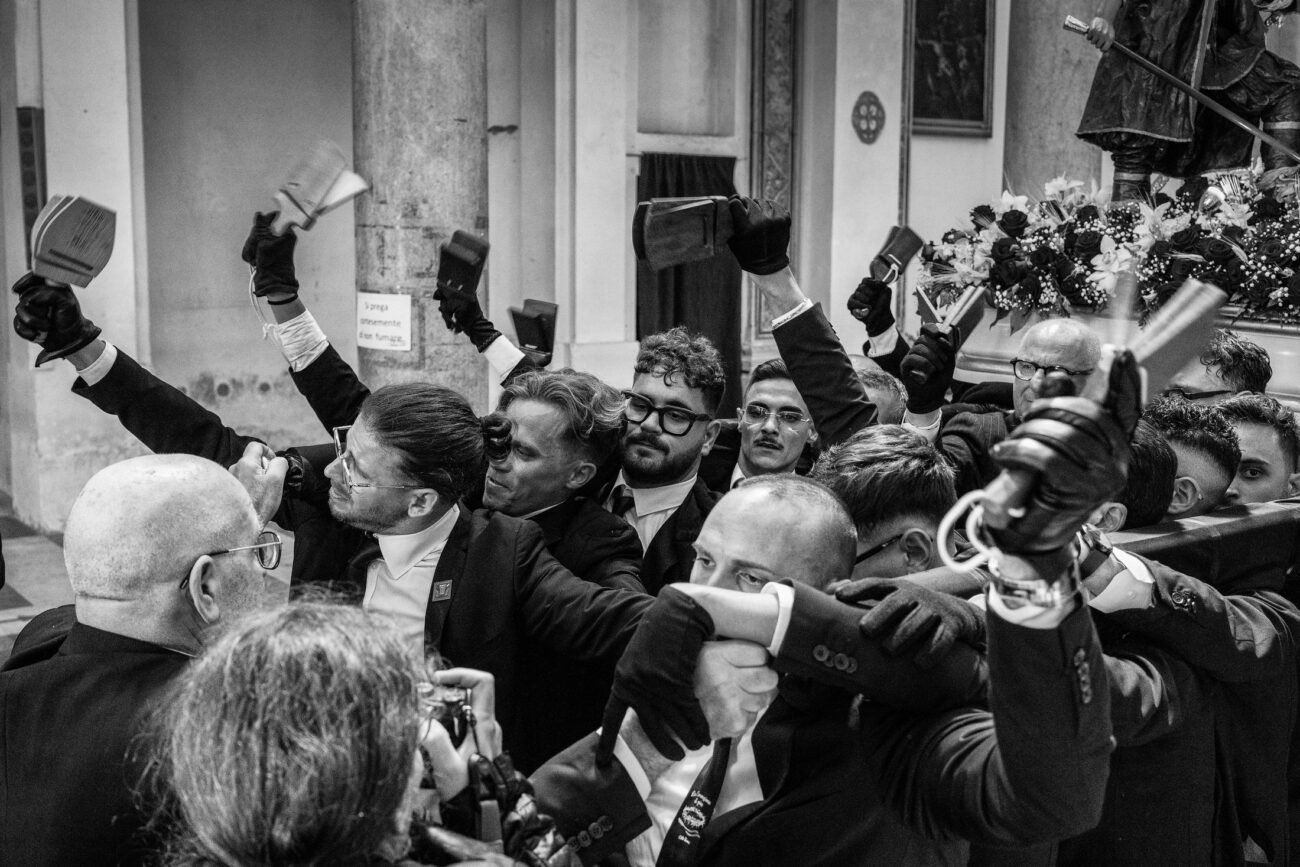
I often follow the first group as it leaves the church and turns into the narrow streets of Trapani. The transition from the quiet interior to the energy of the crowd creates extraordinary photographic opportunities. The concentration of the bearers, the emotion on their faces, the reactions of those watching and the changing relationship between the group and the city all become part of the story unfolding around you.
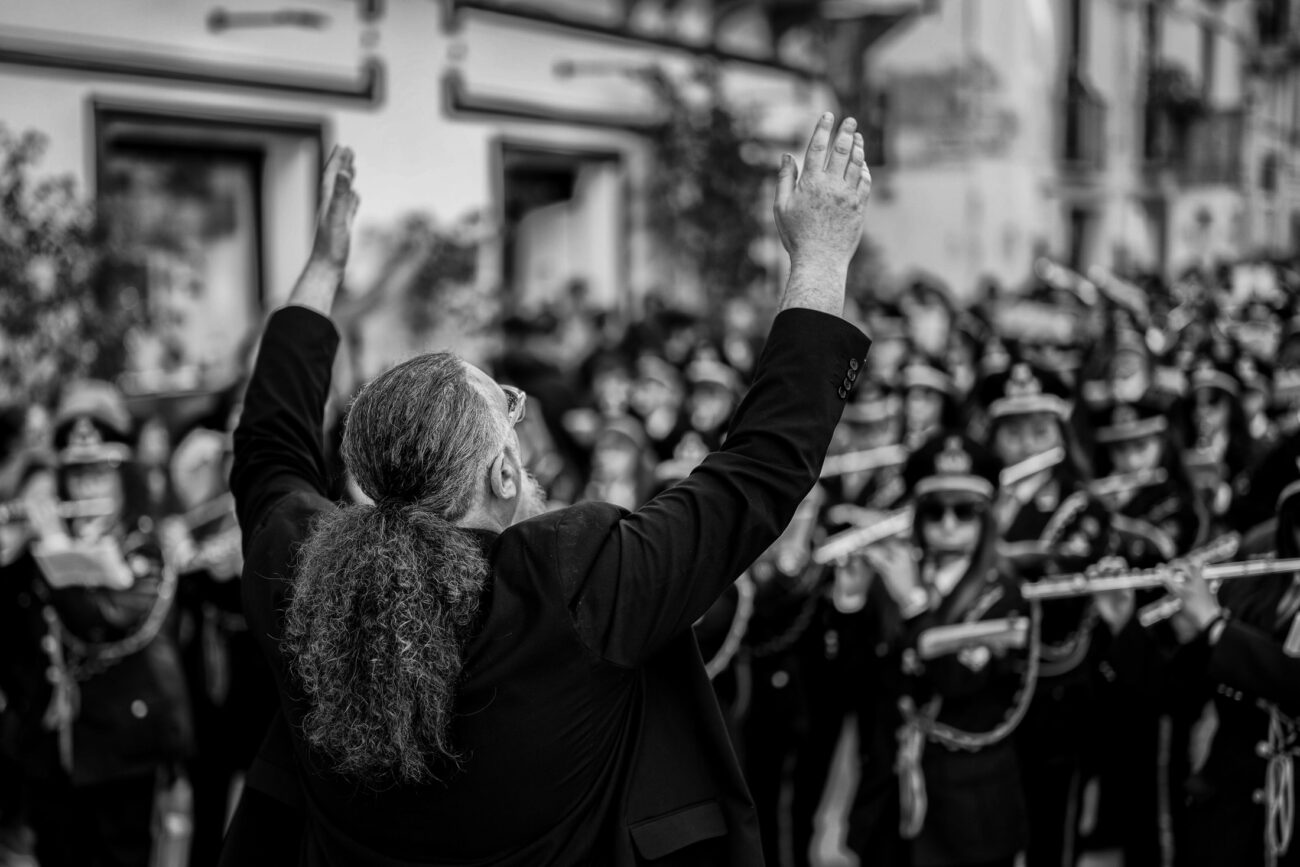
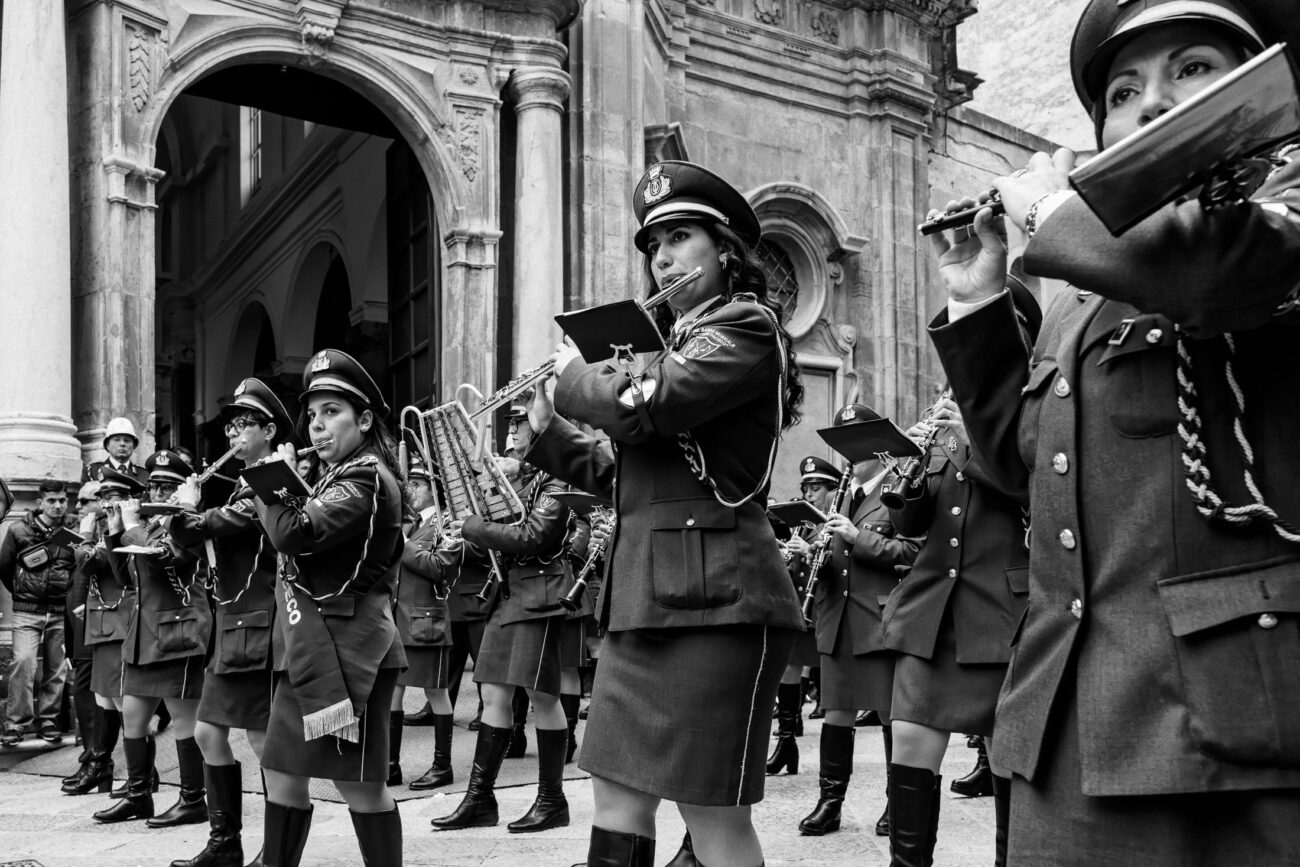
As one group moves away, another band assembles behind it. Then another group follows, and another band. Throughout the afternoon and into the evening, the pattern continues as the sacred groups gradually emerge from the church, each accompanied by its own music, followers and atmosphere.
Together they form one of Sicily’s most extraordinary Easter traditions: a moving procession of faith, history and community that continues through Good Friday, throughout the night and well into the following afternoon.
Following the Procession
By early evening, the atmosphere begins to change. The intensity of the afternoon gives way to a slower rhythm as the procession continues its journey through the streets of Trapani. After hours of photographing, I’ll often spend some time with friends in one of the local restaurants before preparing for what, for me, is one of the most rewarding parts of the entire event.
Before first light the following morning, the city begins to stir again.
As sunrise approaches, the bands assemble and music returns to the streets. The soft morning light brings an entirely different atmosphere to the procession. The crowds are smaller, the pace feels calmer, and there is a sense that both the city and the participants have settled into the long journey that began the previous afternoon.
I usually make my way towards the rear of the procession, where the final group, the Virgin Mary, is progressing through the city. From there, I begin to work my way through the event, moving between the sacred groups, the bands and the people gathered along the streets.
After more than a decade of photographing the Misteri di Trapani, I’ve learnt there is no single way to approach it. Every year reveals something different.
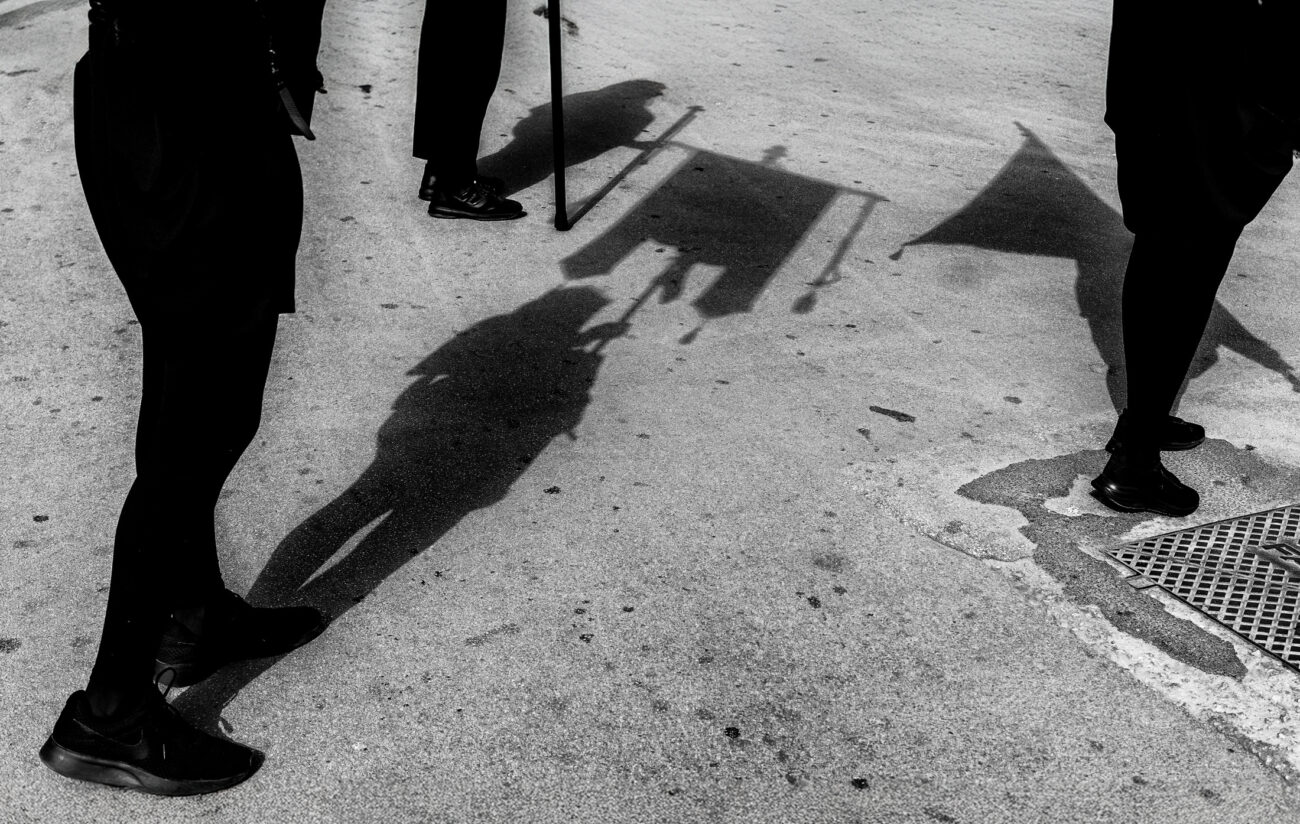
Sometimes I’ll spend an hour concentrating almost entirely on faces, using a longer lens to isolate moments of emotion, concentration or quiet reflection. At other times I’ll return to a 35mm lens and work much closer, looking for the layers, relationships and fleeting gestures that are such an important part of my approach to documentary and street photography.
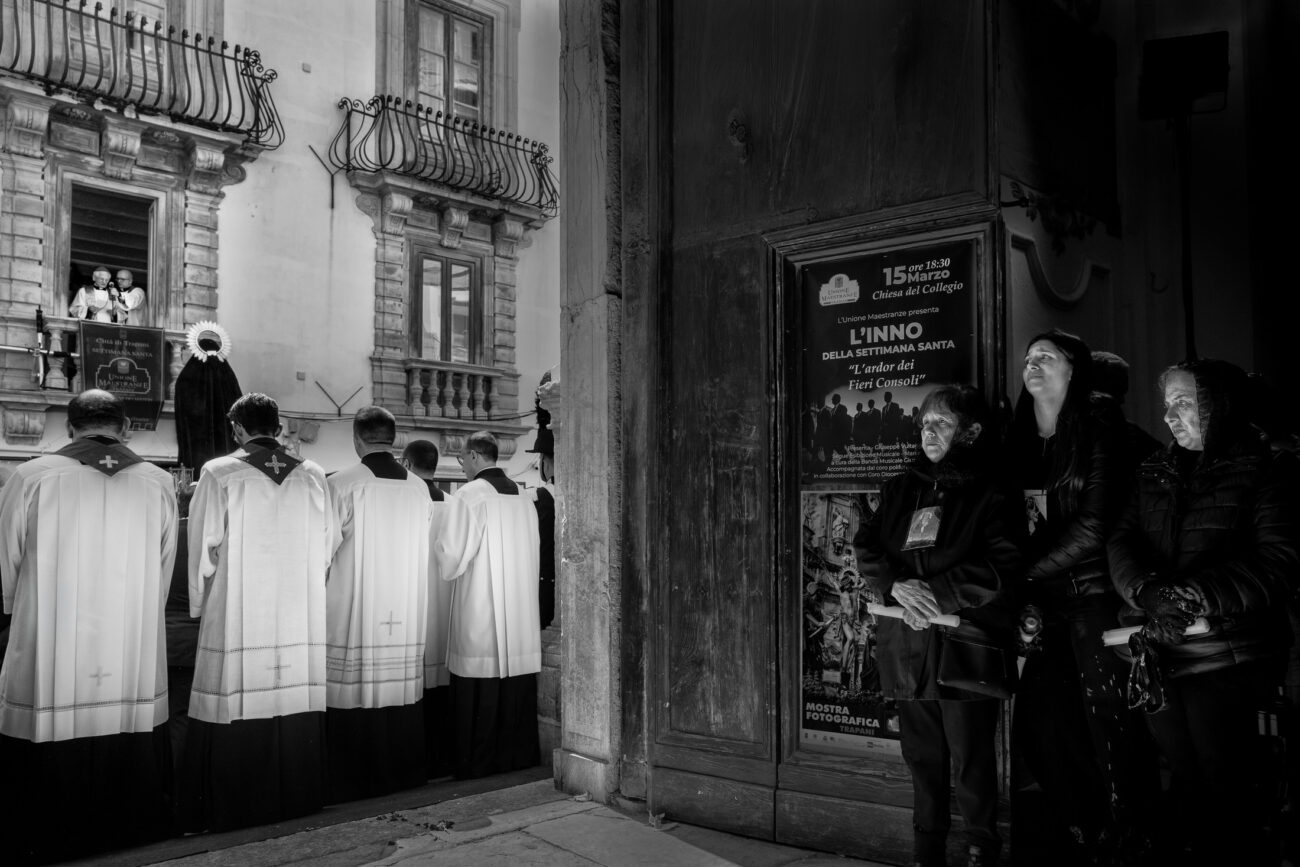
The streets themselves become part of the picture. Balconies, doorways, shopfronts and crowds provide layers within which moments appear and disappear almost instantly. Rather than simply photographing the procession, I’m looking for photographs that say something about the people of Trapani and their relationship with this extraordinary Sicilian tradition.
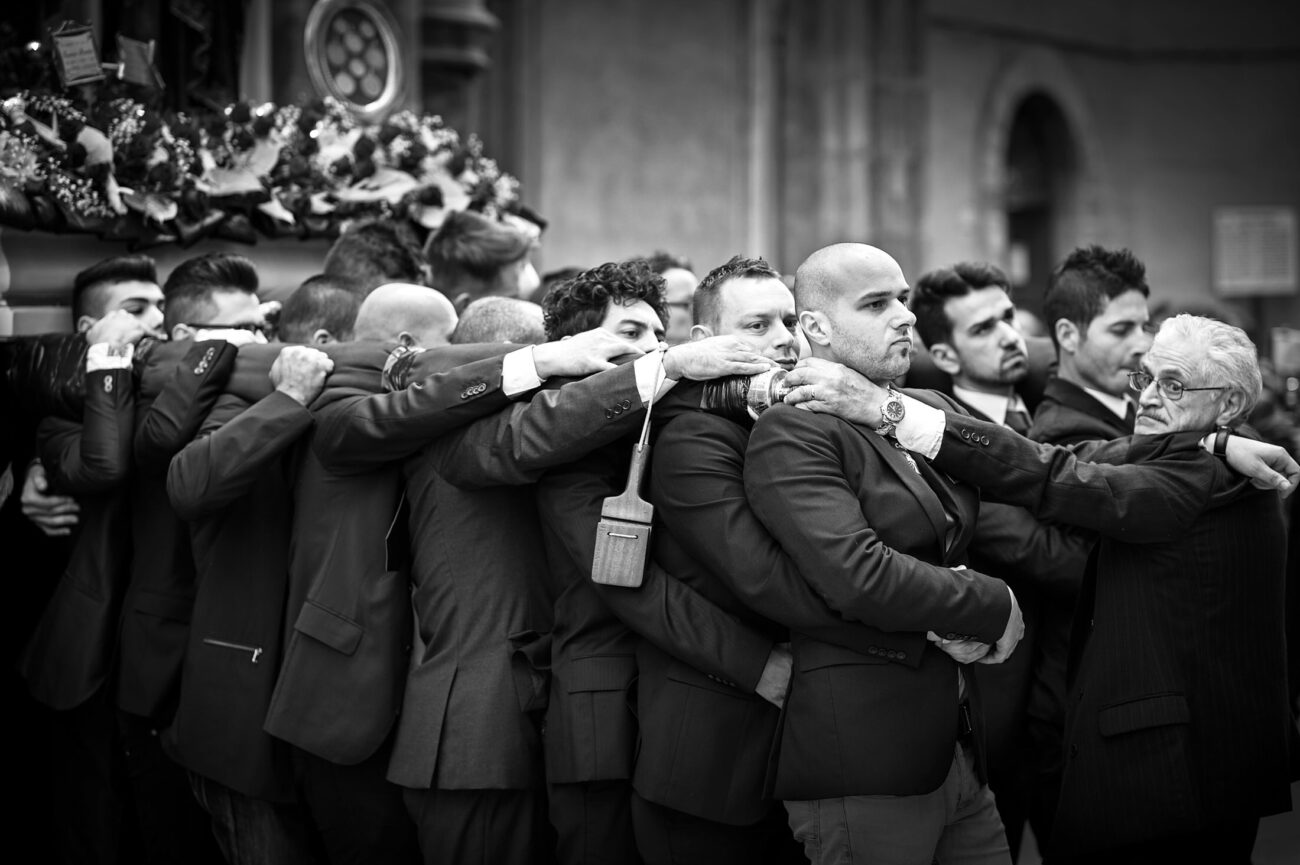
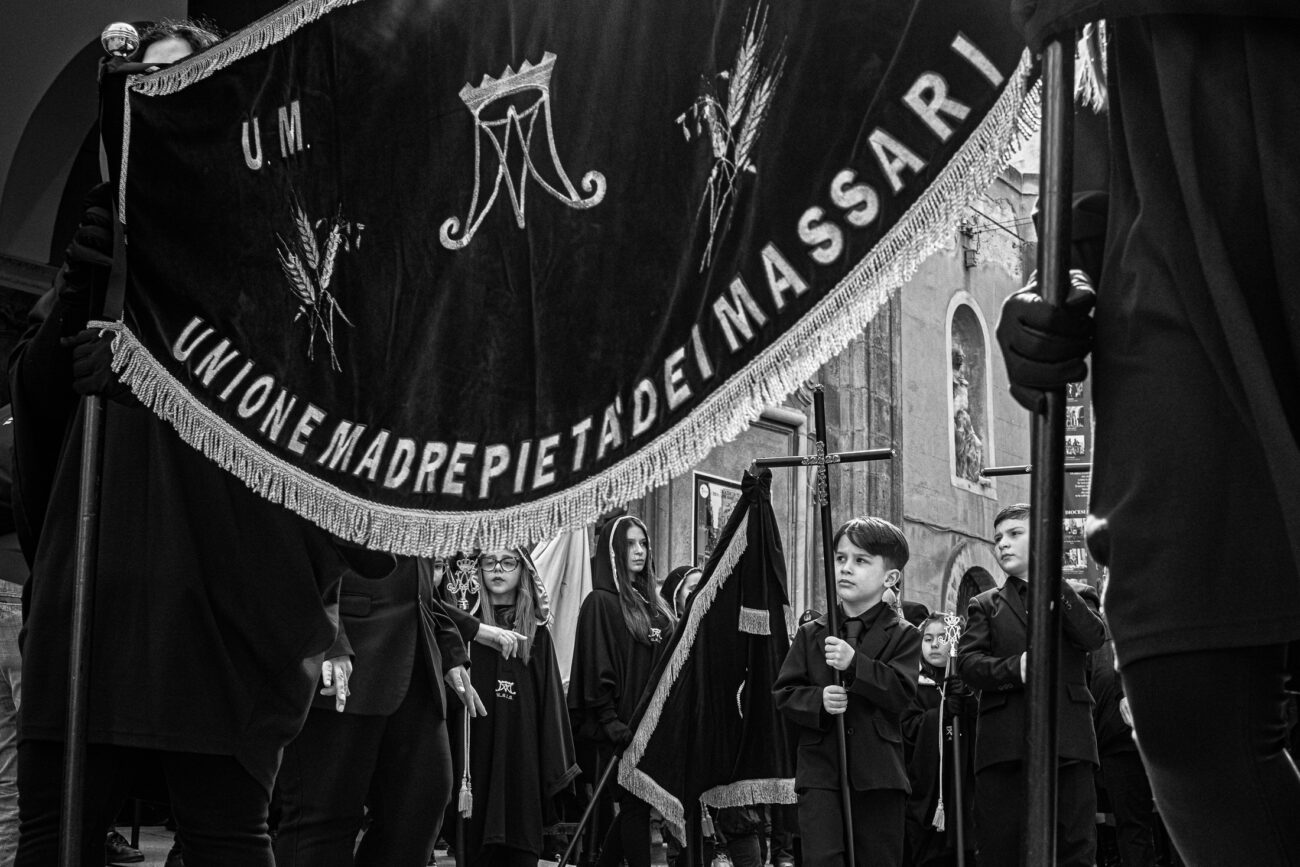
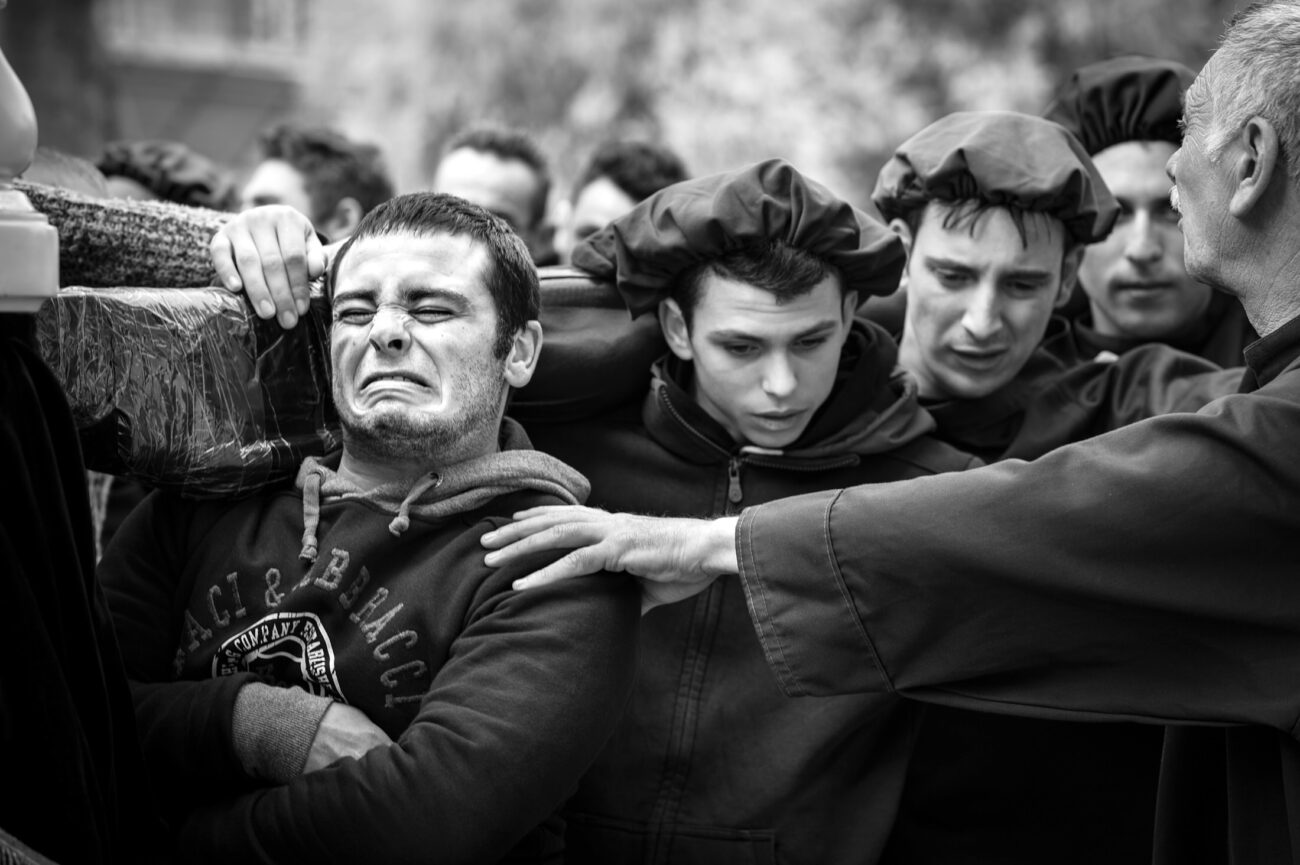
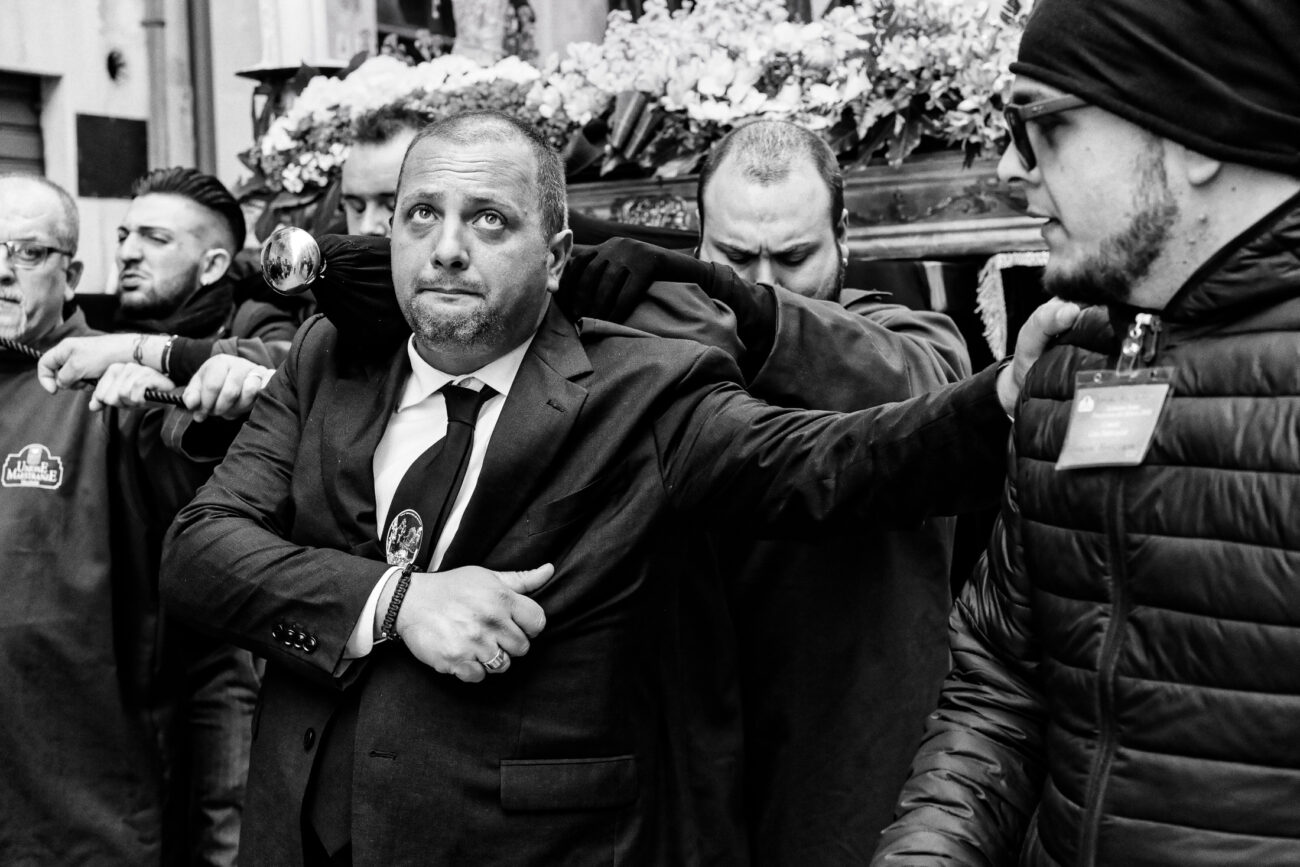
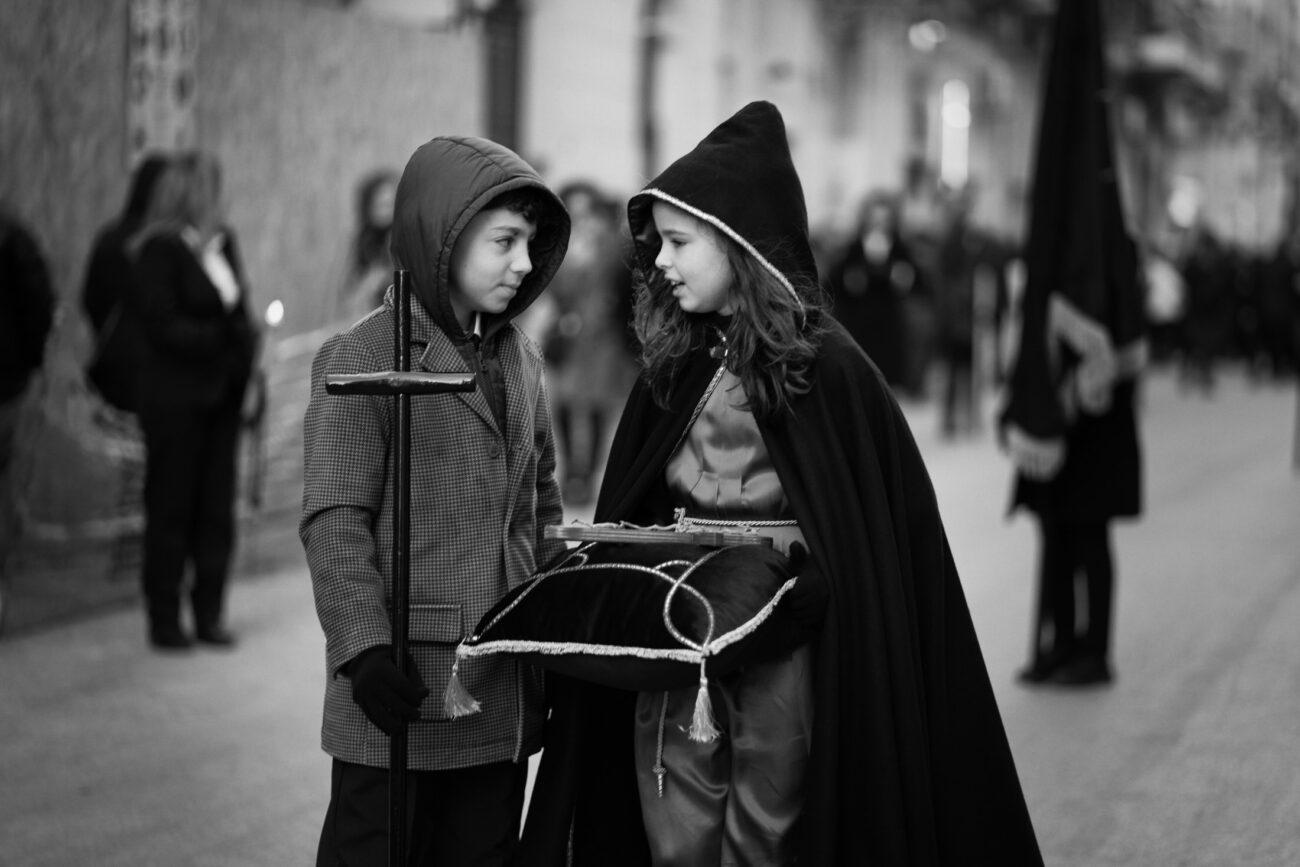
As the morning progresses, my attention is increasingly drawn towards the people who make the Misteri possible: the experienced bearers who have carried the groups for many years, older family members who have dedicated much of their lives to the tradition, musicians, volunteers and faces whose stories will never appear in a guidebook.
The sacred groups are extraordinary, but increasingly it is these quieter human moments that stay with me long after the photographs have been made.
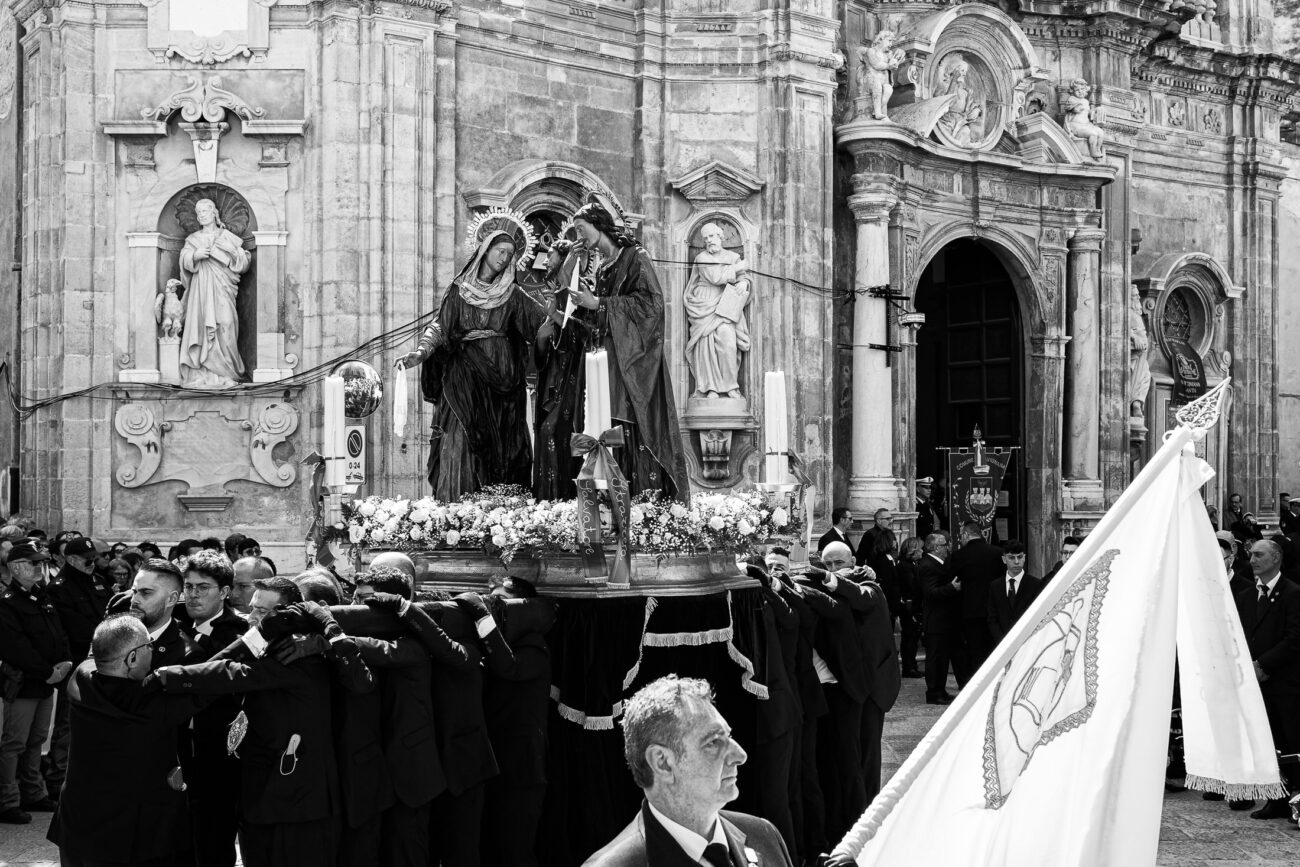
Eventually, after twenty-four hours on the streets of Trapani, the procession approaches its conclusion. By Saturday afternoon, the final group, the Virgin Mary, returns towards the church. Before entering, a reading is delivered and the crowd falls silent. Thousands of people stand listening as the final chapter of the Misteri unfolds before them.
It is a deeply moving moment.
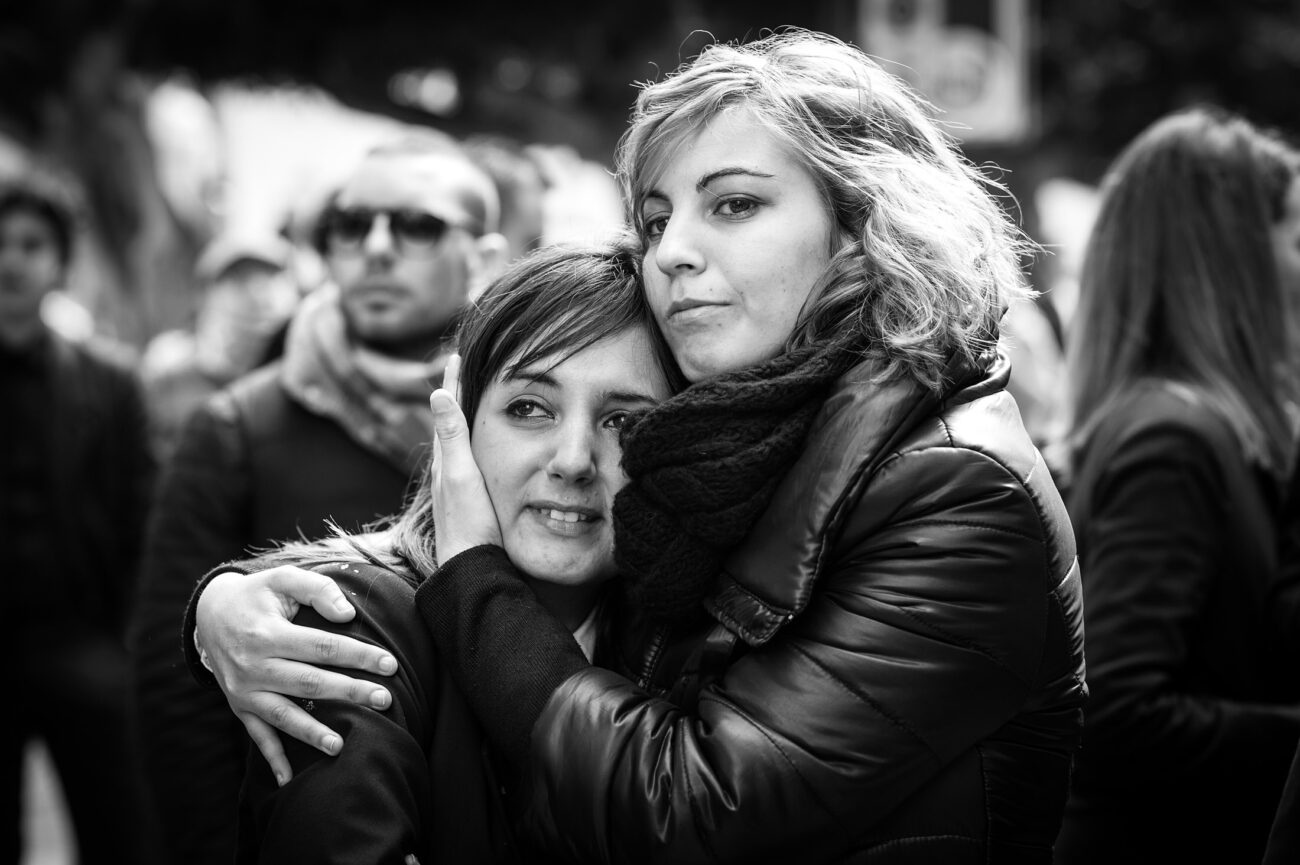
As the Virgin Mary finally returns to the church, emotions held in check throughout the previous day begin to surface. For the bearers, musicians, volunteers and families surrounding them, the Misteri is far more than an event. It is a shared experience built upon faith, friendship, tradition and commitment.
Some embrace. Others quietly reflect. Many simply stand and watch as the doors close behind the final group.
These are often the moments that stay with me most.
As photographers, it is easy to become caught up in the spectacle of an event such as the Misteri di Trapani. The music, crowds and extraordinary visual theatre unfolding around you can be overwhelming. But over the years I’ve realised that the strongest photographs rarely come from chasing the spectacle.
They come from slowing down.
Watching.
Anticipating.
Understanding something about the people in front of you.
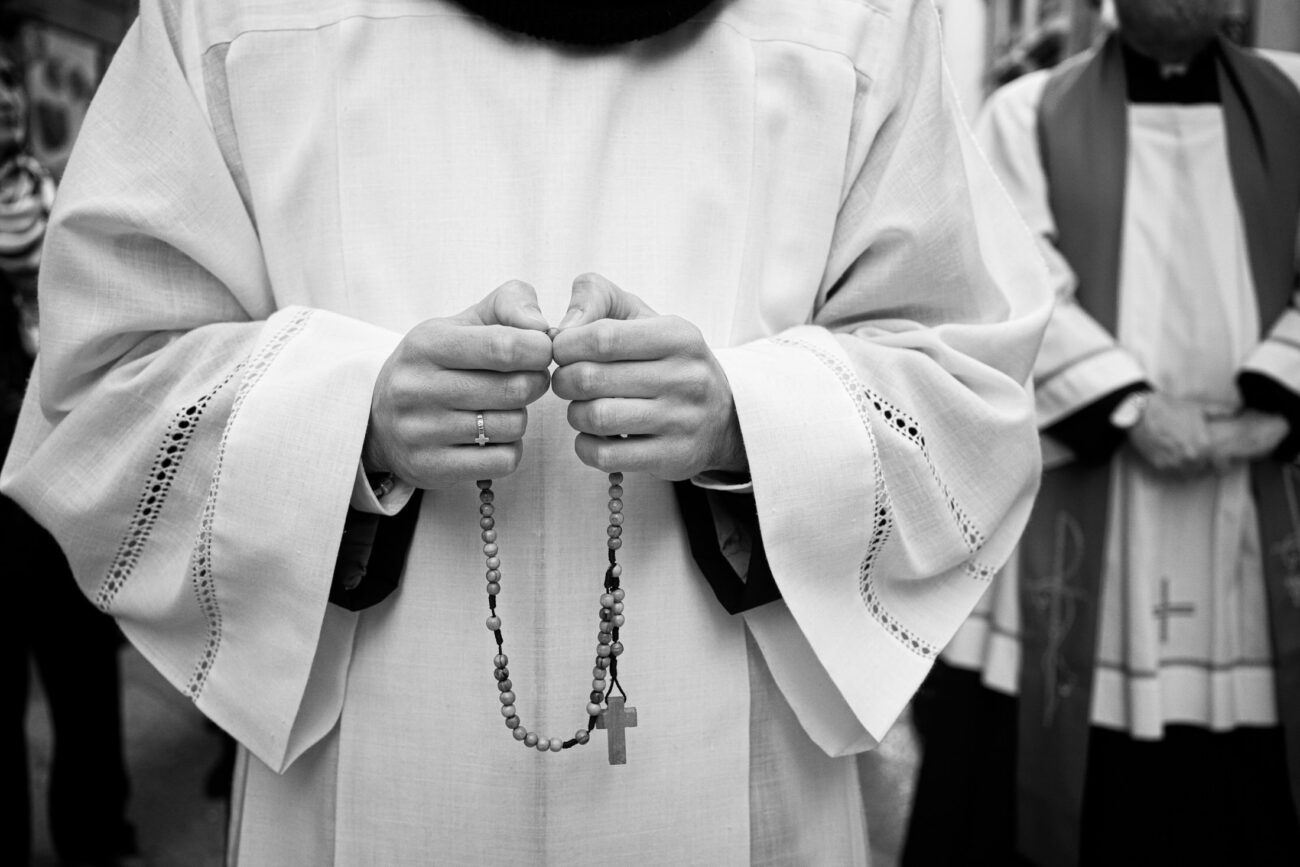
For me, documentary photography is about bearing witness: recognising the significance of the small moments as well as the grand ones, and creating photographs that preserve not simply what happened, but something of what it felt like to be there.
That is what keeps bringing me back to Trapani.
Returning to Trapani
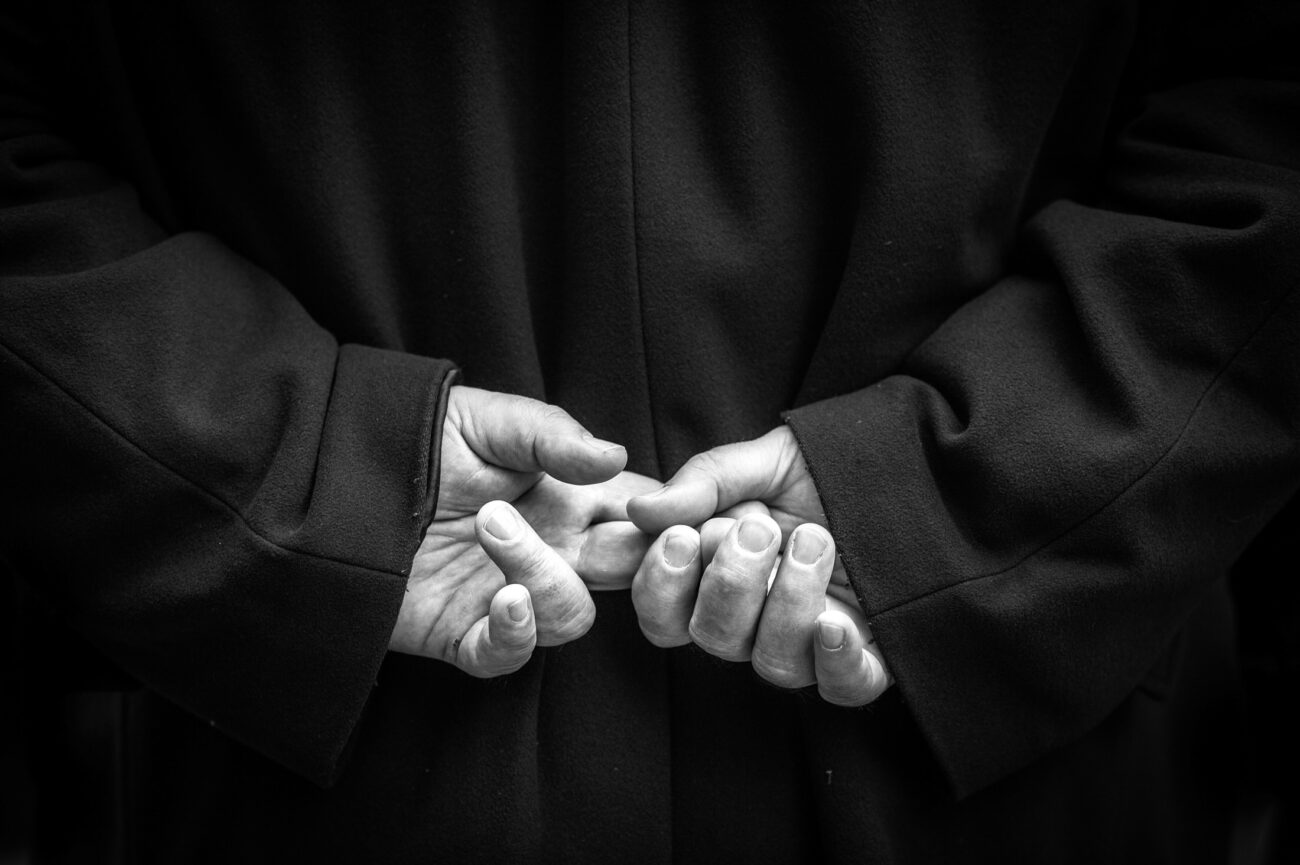
More than a decade after that first visit with my son, I still find myself returning to Trapani each Easter, camera in hand, curious to see what new stories the streets might reveal. The faces change and new generations take their place within the procession, but the spirit of the Misteri endures. It continues to draw me back just as powerfully as it did on that first photographic journey to Sicily in 2014.
Photograph the Misteri di Trapani
A few usefull resources
Each Easter I return to Trapani with a very small group of photographers to experience and photograph this extraordinary tradition from within. Drawing on the relationships and knowledge built over more than a decade, the journey is designed for photographers who want to go beyond the spectacle, understand the story and create more meaningful documentary photographs.
Mark Seymour U Tube https://www.youtube.com/watch?v=N3p76gbxNPI&t=1s
About The Misteri Wikipedia https://it.wikipedia.org/wiki/Processione_dei_Misteri_di_Trapani
A previous blog on the procession https://www.markseymourphotography.co.uk/journal/misteri-di-trapani/
Instagram. How I made the image https://www.instagram.com/reels/DXFBTrDgjXR/
Twenty Photographs Return Home