Lisbon Street Photography Guide | Best Locations & Tips | Mark Seymour
Lisbon is one of my favourite European cities for street photography. In this Lisbon street photography guide, I’ll share some of the best locations I’ve discovered for photographing the city, along with a few suggested photo walks and some favourite places to stop for coffee or food along the way.
I’ll also share some of the techniques I use when photographing Lisbon, particularly my approach to layered street photography: finding the composition first, working with light, placing people carefully within the frame and waiting for the different elements of a photograph to come together.
Every photograph in this guide was made during just two three-day visits to Lisbon. For me, that’s part of what makes the city such a rewarding place to photograph. You don’t necessarily need weeks. With a little planning, a good pair of shoes and an understanding of where and when to photograph, an extraordinary amount can be achieved in just a few days.
At the end, I’ll also explain how you can join me on a future Lisbon street photography workshop and experience photographing the city together.
Bairro Alto: My Favourite Area for Lisbon Street Photography
Bairro Alto is probably my favourite neighbourhood for street photography in Lisbon, which may come as a surprise to photographers who know the city mainly for Alfama and its famous viewpoints.
Early morning is particularly rewarding. The streets are quieter and you see more of the everyday life of the neighbourhood. One of my favourite places to begin is Leitaria Bairro Alto on Rua da Rosa, an old-fashioned café that has retained much of its traditional character. Local residents drop in for coffee and breakfast, and I often start the day here with a coffee and croissant before spending time photographing the activity around the street.
Rua da Rosa itself offers enormous potential for street photography. Rather than constantly moving through the city looking for something to happen, I like to work this relatively short stretch slowly, walking backwards and forwards, finding interesting backgrounds and areas of light and then waiting for people to complete the composition.
It’s particularly good for the kind of layered street photography I enjoy. Doorways, windows, people sitting outside cafés and pedestrians moving at different distances through the frame provide opportunities to build photographs with several points of interest rather than relying on a single subject.
By late afternoon and early evening, the character of Bairro Alto changes again. Cafés and bars become busier, people gather outside to drink and talk, and the streets gradually fill. There are more visitors, but you can still find scenes of everyday Lisbon life away from the busiest tourist routes.
I’ve made some of my favourite Lisbon street photographs along this small section of Rua da Rosa. It’s a good reminder that productive street photography doesn’t always require covering miles of a city. Sometimes it is better to find one promising street, understand how the light and people change throughout the day, and keep returning to it.
Where to Eat in Bairro Alto
For an evening meal, one place I particularly enjoyed was Tasquinha Canto do Fado, also on Rua da Rosa. It’s a small, intimate restaurant with a short menu of traditional Portuguese food. We enjoyed it enough to return more than once.
There’s also the possibility of hearing traditional Fado while you eat, which makes for a memorable evening after a day photographing the streets.
One warning: when the Fado begins, conversation stops. You stay quiet and listen.


Praça do Comércio and the Tagus Riverfront
Praça do Comércio is one of Lisbon’s most recognisable locations and, despite being busy with visitors, the whole area offers plenty of opportunities for street photography in Lisbon.
The square itself is always active, but I particularly like working my way towards the Tagus River. People sit along the waterfront, meet friends, talk in small groups and simply enjoy the sunshine. Children often gather around the street performers and giant soap bubbles, creating another layer of activity to work with.
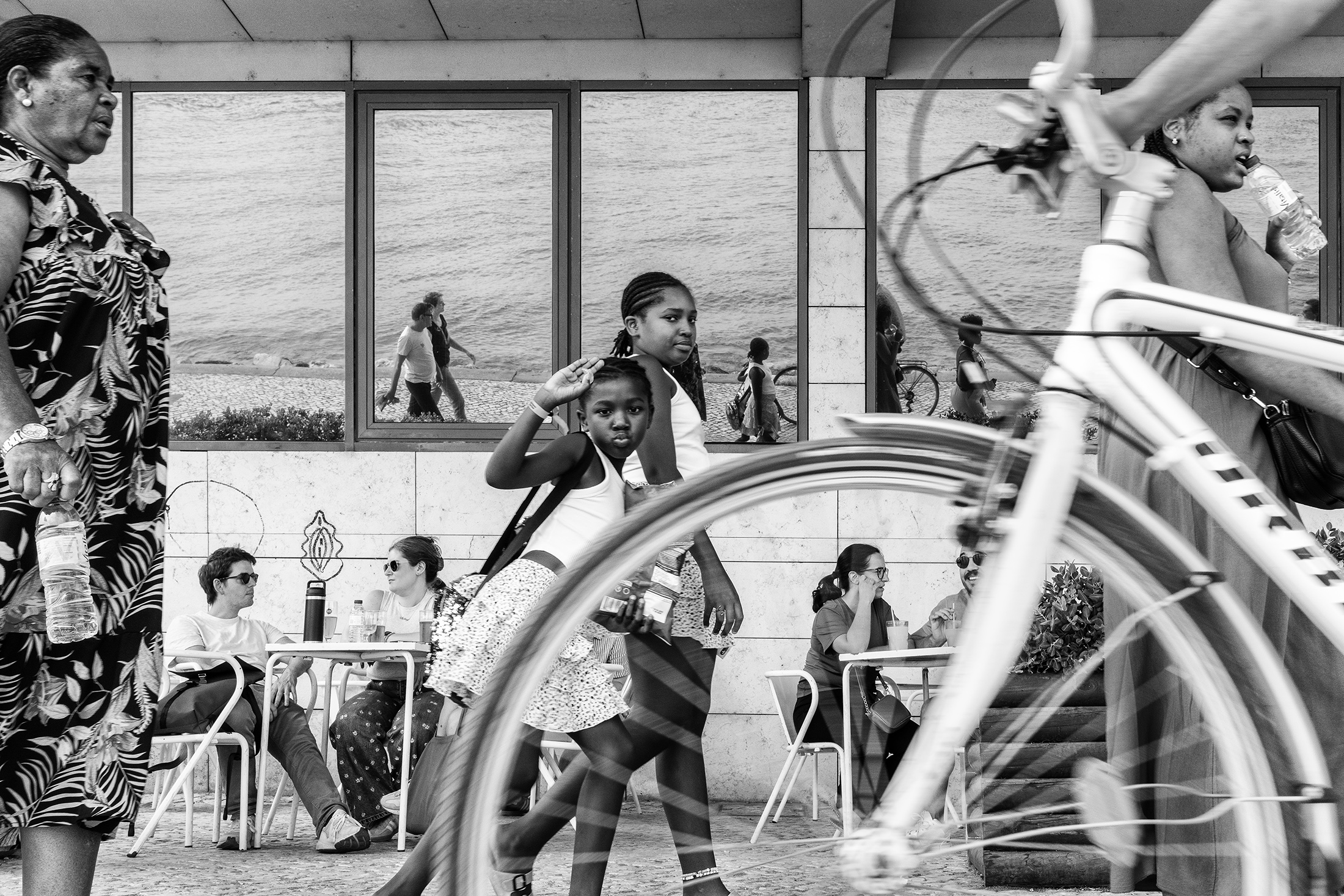
Continue a little further along the riverfront and you’ll come to a café with a large mirrored background. This is exactly the sort of location I look for when making layered street photographs.
Rather than immediately photographing what is happening, find your position first. Look carefully at the reflections, make sure you’re not appearing in the glass yourself, and start watching how people move through the different parts of the frame.
Then wait.
One person might give you the foreground, another appears within the reflection, while something completely different happens further into the scene. The challenge is recognising the moment when those separate elements briefly come together.
How many layers can you get into the frame while still making the photograph work?
People often ask me how I see these multi-layered compositions. It’s difficult to explain because, after years of working this way, I don’t consciously search for every individual element.
But it can be learned.
The more you practise standing still, watching the edges of the frame and anticipating where people are going to move, the more these compositions begin to reveal themselves. Eventually, rather than having to search for them, they seem to jump out at you.


MAAT to Belém Tower: A Lisbon Photography Walk
Belém is well worth adding to a Lisbon street photography itinerary, but rather than travelling directly to Belém Tower, I recommend taking an Uber to MAAT, the Museum of Art, Architecture and Technology, and then walking west along the Tagus towards the tower.
It’s a lovely riverside walk and, photographically, the journey is more interesting than simply arriving at the destination. The area around MAAT and the waterfront is busy with visitors, local families, cyclists and street performers, so there is usually plenty happening within the frame.
Don’t be put off by the fact that this is one of Lisbon’s more touristy areas. Crowds can actually work extremely well for layered street photography, particularly when you stop trying to isolate individual subjects and instead look for relationships between people at different distances within the scene.
I tend to walk slowly, find an interesting composition and then wait to see what develops. Watch the foreground as carefully as the background and pay particular attention to the edges of the frame. With enough patience, several completely unrelated moments can briefly come together to create one photograph.
The walk eventually brings you to Belém Tower, but for me the photographs made along the way are often more interesting than the landmark itself.
Here are a few examples of the layered street photographs I’ve made while walking this stretch of Lisbon’s waterfront.


Alfama: Street Photography in Lisbon’s Oldest Neighbourhood
Alfama is one of the traditional hunting grounds for street photography in Lisbon, with its maze of narrow streets, steep stairways and small squares where everyday life continues alongside the visitors exploring the neighbourhood.
You’ll encounter children playing in the streets, older residents sitting outside cafés or talking on benches, washing hanging between buildings and people watching the world from windows and doorways. There is plenty to photograph, but my best advice for Alfama is very simple: wander and allow yourself to get lost.
Rather than following a fixed route between the obvious viewpoints, turn into the smaller streets and see where they take you. Walk slowly, look into the side streets and stairways, and give yourself time to observe what is happening. For documentary and street photography, the quieter moments of everyday life are often far more interesting than the famous views.
Alfama is also a good place to practise layered street photography. The narrow streets naturally create depth, with doorways, windows, balconies and people appearing at different distances within the frame. Find a composition that interests you and wait. Often the photograph develops simply because you’ve stayed in one place long enough.
Where to Eat in Alfama
We discovered a couple of excellent places here, but A Baiuca was the standout for a traditional Lisbon experience. It’s tiny, seating only around 28 people, and combines simple Portuguese food with intimate Fado performances.
Book ahead and arrive early. This is not somewhere I’d casually turn up expecting a table, and even being a few minutes late can mean losing your reservation.
Just opposite is Lautasco, a lovely place to stop for a glass of wine beforehand. The combination worked brilliantly for us: a drink at Lautasco followed by dinner and Fado at A Baiuca


Different Street Photography Techniques in Lisbon
One of the things I particularly enjoy about street photography in Lisbon is the quality of the light. Rather than photographing everything in the same way, we used different parts of the city to experiment with a variety of techniques and approaches.
We worked with light and shadow, looking for strong areas of contrast and waiting for people to move into exactly the right position within the frame. We experimented with colour matching, finding relationships between clothing, buildings, signs and other elements within a scene.
We also looked for layers, reflections and repeating shapes, and occasionally simply allowed a little humour into the photographs. Street photography doesn’t always have to be serious. Sometimes an unexpected gesture, expression or visual coincidence is enough to make a photograph work.


Join Me for a Lisbon Street Photography Workshop
I run a small number of Lisbon street photography workshops, working with no more than five photographers at a time.
Over several days, we’ll explore some of my favourite areas of Lisbon, from the quieter streets of Bairro Alto and Alfama to the busy riverfront and locations that offer particularly good opportunities for documentary and layered street photography.
The small-group format means we can work slowly and respond to what we find rather than following a rigid photographic itinerary. I’ll work alongside you throughout the day, helping you with composition, timing, light and shadow, and particularly how to recognise and build the layered compositions that form such an important part of my own photography.
We’ll photograph together, stop for coffee and lunch when it makes sense, and usually finish the day around a table over dinner. If you’d like to review your photographs with me, we’ll also spend time looking at your work and discussing what is working, what could be stronger and how you can develop your photography further.
These workshops aren’t about collecting photographs of Lisbon’s landmarks. They’re about learning to observe more carefully, anticipate moments and make stronger photographs of the everyday life unfolding around you.
Explore Lisbon Photography Workshops →
or
Enquire About a Private Lisbon Photography Journey →
How I Photograph Layers → your own Journal article
Personal Photography Mentoring → your Mentoring page
Lisbon Photography Workshops → your Lisbon Journey page